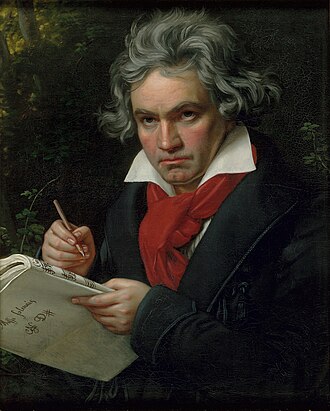
> LUDWIG VAN BEETHOVEN
German composer whose bold, emotionally powerful works helped bridge the Classical and Romantic eras.
Overview
Ludwig van Beethoven was a German composer and pianist whose music transformed the Western classical tradition. Working at the turn of the nineteenth century, he expanded the scale and emotional range of the symphony, sonata, concerto, and string quartet. His ability to continue composing as his hearing deteriorated has also made him an enduring symbol of artistic determination.
Key Facts
- Born in Bonn and established his career in Vienna
- Composed nine symphonies, five piano concertos, and one opera, Fidelio
- Wrote many of his greatest works while severely deaf
- His Ninth Symphony concludes with a choral setting of “Ode to Joy”
History and Career
Beethoven received early musical training from his father and other teachers in Bonn. He moved to Vienna in 1792, studied with Joseph Haydn, and first became famous as a virtuoso pianist and improviser. Around 1800 he began to recognize that he was losing his hearing. Rather than abandon music, he entered a remarkably productive period that produced works including the Eroica Symphony, Fifth Symphony, and Appassionata Sonata.
Musical Style and Structure
Beethoven inherited balanced Classical forms from Haydn and Mozart but stretched them through longer development, sharp contrasts, rhythmic drive, and recurring motifs. The famous four-note opening of the Fifth Symphony shows how a small musical idea can organize an entire movement. His late quartets and piano sonatas became more experimental, using unusual forms, harmonic shifts, and intimate expression.
Impact / Legacy
Beethoven changed expectations of what instrumental music could communicate. Romantic composers treated him as a model of the independent artist expressing personal struggle and heroic ambition. His symphonies remain central to orchestral repertory, while “Ode to Joy” has become an international symbol of unity.
Did You Know?
- Beethoven’s Third Symphony was originally associated with Napoleon before the composer angrily removed the dedication.
- He premiered several works despite being unable to hear the audience clearly.
- The opening theme of the Fifth Symphony uses only four notes.
- “Ode to Joy” is used as the anthem of the European Union.