> THEATRE OF DIONYSUS
Ancient Greek theater in Athens regarded as the birthplace of drama and the performance site of major classical tragedies and comedies.
Overview
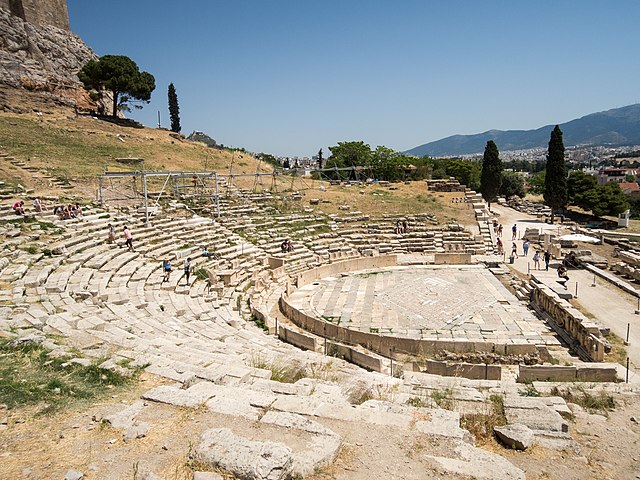
The Theatre of Dionysus is one of the most important cultural sites of the ancient world. Located on the southern slope of the Acropolis in Athens, it is widely regarded as the birthplace of Western theater. Here, dramatic performance developed into a formal art form that would shape literature and performance traditions for centuries.
History
The theater was originally associated with festivals honoring Dionysus, the Greek god of wine, fertility, and theater. In its earliest form, performances likely took place in a simpler wooden structure during the 6th century BC. Over time, the site was expanded and rebuilt in stone, reflecting the increasing importance of drama in Athenian civic life. By the 5th century BC, Athens had become the center of tragedy and comedy, and the Theatre of Dionysus served as the principal venue for major dramatic competitions.
Drama and Cultural Importance
The works of Aeschylus, Sophocles, Euripides, and Aristophanes were performed here, making the theater central to the development of tragedy and comedy. These plays were not merely entertainment. They engaged with politics, religion, war, law, and moral responsibility. Public attendance at dramatic festivals was part of civic identity, and the theater functioned as a space where Athenians reflected on the values and tensions of their society.
Structure and Legacy
The theater eventually held thousands of spectators and included a circular orchestra, stage buildings, and tiered seating carved into the hillside. Although only ruins remain today, the site’s influence is enormous. The Theatre of Dionysus stands as a symbol of artistic innovation and democratic public culture in classical Athens. It remains a key reference point for historians, archaeologists, playwrights, and theater lovers worldwide.
Did You Know?
- Plays by Sophocles, Euripides, and Aristophanes were staged here.
- It is located directly below the Acropolis in Athens.
- Ancient dramatic festivals were religious as well as civic events.
- The site is often called the birthplace of Western theater.