> INDUSTRIAL REVOLUTION
A period of rapid mechanization and factory growth that transformed production, labor, transport, and daily life.
Overview
The Industrial Revolution was a major period of economic and technological change that began in Britain around 1760 and spread to Europe and North America. It marked the shift from hand production and small workshops to machine-based manufacturing in factories. New power sources, especially water and steam, allowed goods to be produced faster, cheaper, and in far greater quantities than before.
This transformation affected nearly every part of society. Textile making, iron production, coal mining, and transportation all changed rapidly. The Industrial Revolution also reshaped cities, labor systems, and global trade. Although it brought higher productivity and long-term economic growth, it also created harsh working conditions, crowded urban housing, and environmental damage.
Background
Several factors helped Britain become the birthplace of the Industrial Revolution. The country had large coal and iron deposits, a growing population, and access to global markets through trade and empire. Agricultural improvements had increased food production, which supported population growth and freed some workers for industrial jobs.
Britain also had strong financial institutions and a culture of invention. Investors could fund new machinery and factories, while inventors tested ways to improve production. Earlier scientific thinking and practical engineering encouraged experimentation, leading to a wave of useful innovations.
Key Developments
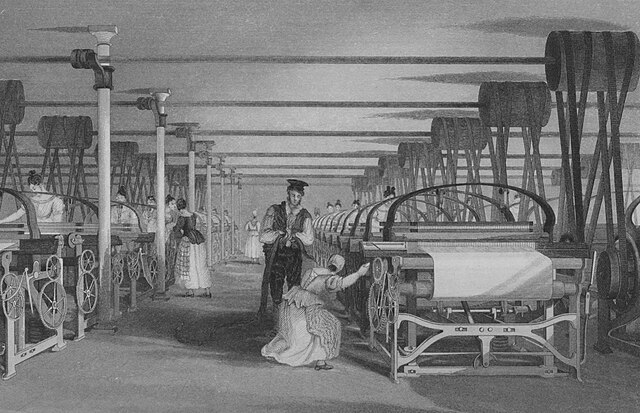
Textiles were at the center of early industrialization. Inventions such as the spinning jenny, water frame, and spinning mule greatly increased yarn production. Edmund Cartwright’s power loom later sped up weaving. These machines moved textile work out of homes and into factories, where employers could supervise workers and machinery more easily.
Steam power became another defining feature of the era. James Watt’s improvements to the steam engine in the late 18th century made it more efficient and useful in many industries. Steam engines pumped water from mines, powered factory machines, and eventually drove locomotives and steamships.
Iron production also advanced. Abraham Darby’s use of coke instead of charcoal helped make iron cheaper, while Henry Cort’s puddling and rolling processes improved quality and output. Better iron supported machinery, tools, bridges, and railways.
Transportation changed dramatically as roads, canals, and railways expanded. Railroads in particular reduced travel time and lowered shipping costs, linking industrial centers with ports, mines, and markets.
Impact and Legacy
The Industrial Revolution created a new industrial economy. Factory owners, merchants, and investors gained influence, while many workers left rural areas to seek employment in towns and cities. Urbanization accelerated, and places like Manchester became symbols of industrial growth.
Working conditions were often severe. Men, women, and children labored long hours in dangerous factories and mines for low wages. These conditions led to protests, trade union activity, and eventually government reforms, including laws regulating child labor and factory safety.
Its global legacy was enormous. Industrial methods spread across Europe, the United States, and later much of the world. The Industrial Revolution laid the foundation for modern manufacturing, mass transportation, and capitalist economies. It also widened the gap between industrialized and non-industrialized regions, shaping global power in the 19th century and beyond.
Did You Know?
- The spinning jenny, invented by James Hargreaves, allowed one worker to spin multiple spools of thread at once.
- Early factories often employed children because they were paid less and could handle small machines.
- Britain’s first public steam railway to use locomotives, the Stockton and Darlington Railway, opened in 1825.
- Manchester became known as “Cottonopolis” because of its huge textile industry.
- The Industrial Revolution began in Britain before spreading to Belgium, France, Germany, and the United States.