> ASSASSINATION OF ARCHDUKE FRANZ FERDINAND
The 1914 killing of Archduke Franz Ferdinand in Sarajevo triggered the July Crisis and helped ignite World War I.
Overview
The assassination of Archduke Franz Ferdinand took place on 28 June 1914 in Sarajevo, then part of Austria-Hungary. Franz Ferdinand, heir presumptive to the Austro-Hungarian throne, was killed along with his wife, Sophie, Duchess of Hohenberg, by Gavrilo Princip, a Bosnian Serb nationalist. The attack is widely remembered as the spark that set off World War I, though the deeper causes of the war had been building for years through rival alliances, militarism, nationalism, and imperial competition.
The event became a turning point in modern history because Austria-Hungary used the assassination as grounds to confront Serbia. What followed was the July Crisis, a chain of diplomatic ultimatums, mobilizations, and war declarations that drew Europe’s great powers into a global conflict.
Background
By 1914, the Balkans were among the most unstable regions in Europe. Austria-Hungary had formally annexed Bosnia and Herzegovina in 1908, angering many Serbs and Slavic nationalists who wanted these territories united with Serbia or included in a larger South Slav state. Nationalist groups opposed Habsburg rule and viewed Franz Ferdinand’s visit to Sarajevo as a political provocation.
The assassins were linked to a secretive network of young Bosnian activists, often associated with Young Bosnia, and they received support from elements connected to the Serbian nationalist organization known as the Black Hand. Their goal was to strike a symbolic blow against Austro-Hungarian authority.
The Event
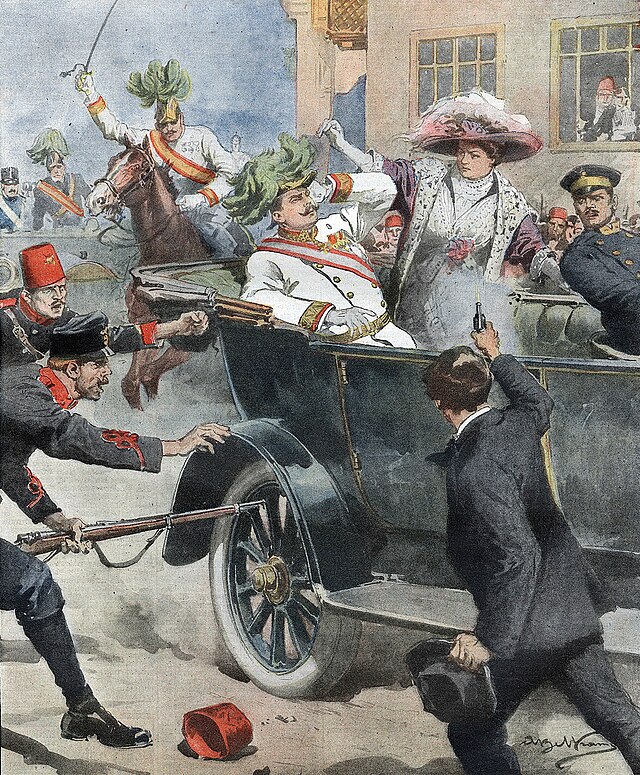
On the morning of 28 June, Franz Ferdinand and Sophie traveled through Sarajevo in an open car as part of an official visit. Several conspirators were positioned along the motorcade route. One assassin, Nedeljko Čabrinović, threw a bomb at the archduke’s car, but it missed and exploded under a following vehicle, injuring several people.
Despite this failed attempt, the royal couple continued with their schedule. Later, after deciding to visit those wounded in the bombing, their driver took a wrong turn near the Latin Bridge. By chance, the car stopped close to Gavrilo Princip, who had remained nearby after the earlier attack. Princip stepped forward and fired two shots, fatally wounding Franz Ferdinand and Sophie. Both died shortly afterward.
The date of the assassination, 28 June, also carried symbolic weight in Serbian history, as it was Vidovdan, linked to the medieval Battle of Kosovo.
Impact and Legacy
The assassination did not make war inevitable by itself, but it triggered a crisis in an already tense Europe. Austria-Hungary, backed by Germany, issued a harsh ultimatum to Serbia. Although Serbia accepted many of its demands, Austria-Hungary declared war on 28 July 1914. Russia mobilized in support of Serbia, Germany declared war on Russia and France, and Britain soon entered the conflict after Germany invaded Belgium.
The result was World War I, a war that lasted from 1914 to 1918 and reshaped global politics. The conflict led to the collapse of empires, including Austria-Hungary, the Ottoman Empire, the German Empire, and the Russian Empire. It also set conditions that contributed to World War II.
Today, the assassination of Archduke Franz Ferdinand is studied as a key example of how a single event can trigger far-reaching consequences when international tensions are already high.
Did You Know?
- Franz Ferdinand was not especially popular within Austria-Hungary, but his death became a powerful political rallying point.
- Gavrilo Princip was too young to receive the death penalty under Austro-Hungarian law, so he was sentenced to prison instead.
- The assassination took place near Sarajevo’s Latin Bridge, a site that remains closely associated with the event.
- The first assassination attempt that day failed, and the successful attack happened only because the archduke’s car stopped after a wrong turn.