> BATTLE OF WATERLOO
The Battle of Waterloo ended Napoleon’s rule, reshaped Europe, and marked a decisive Allied victory on 18 June 1815.
Overview
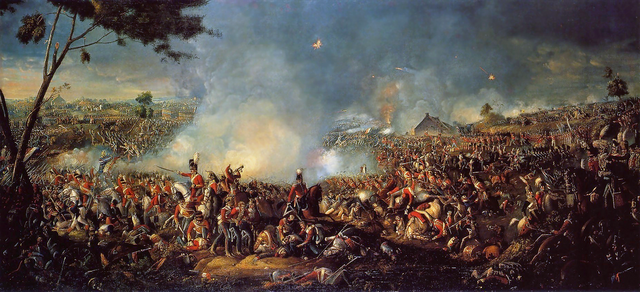
The Battle of Waterloo was fought on 18 June 1815 near Waterloo in present-day Belgium. It was the final major battle of Napoleon Bonaparte’s military career and a decisive turning point in European history. French forces under Napoleon faced the Allied army led by the Duke of Wellington, supported later in the day by Prussian troops commanded by Gebhard Leberecht von Blücher. The Allied victory ended Napoleon’s Hundred Days campaign and brought his rule to a permanent close.
Waterloo is often remembered as the battle that ended years of revolutionary and Napoleonic warfare across Europe. Its outcome helped restore the balance of power on the continent and shaped international politics for decades.
Background
After being exiled to Elba in 1814, Napoleon escaped and returned to France in March 1815. He quickly regained power, beginning the period known as the Hundred Days. European powers, already gathered at the Congress of Vienna, reacted by forming the Seventh Coalition and preparing to invade France.
Napoleon moved first. His strategy was to strike rapidly in Belgium before Coalition armies could fully unite. He hoped to defeat Wellington’s Anglo-Allied army and Blücher’s Prussian army separately. Initial French successes at battles such as Ligny showed that Napoleon still posed a major threat, but the Coalition forces remained in the field and prepared for a larger confrontation.
The Battle
The battlefield south of Brussels was shaped by muddy ground, farms, and ridges that affected troop movement and artillery. Wellington chose a defensive position near Mont-Saint-Jean, where his forces could shelter behind a ridge. Strongpoints such as Hougoumont, La Haye Sainte, and Papelotte became crucial parts of the fighting.
The battle began late in the morning, partly because heavy rain the night before had soaked the ground. French attacks opened against Hougoumont, which became a prolonged and costly struggle. Napoleon then launched assaults against Wellington’s center and left, but Allied infantry held firm under intense pressure.
One of the most famous episodes came when Marshal Ney led repeated cavalry charges against Allied lines. Without sufficient infantry and artillery support, the cavalry failed to break Wellington’s troops, who formed defensive squares. Meanwhile, La Haye Sainte eventually fell to the French, creating a dangerous moment for the Allies.
The battle’s decisive phase came in the evening, when Prussian forces arrived in increasing strength on Napoleon’s right flank. Their pressure forced the French to divide attention and manpower. Napoleon’s final gamble, the advance of the Imperial Guard, was repulsed by Allied troops. As the Guard retreated, the French army collapsed into general retreat.
Impact and Legacy
Waterloo ended Napoleon’s reign for good. He abdicated soon after the battle and was exiled to Saint Helena, where he spent the rest of his life. The victory strengthened the post-Napoleonic settlement shaped by the Congress of Vienna and encouraged a long period of relative great-power stability in Europe.
The Battle of Waterloo also entered popular memory as a symbol of final defeat. Its name became shorthand for a crushing end to ambition. Historians continue to study the battle for its leadership decisions, battlefield coordination, and the importance of timing, terrain, and coalition warfare.
Did You Know?
- The battle was fought on 18 June 1815, but the campaign around it included several related clashes in the same week.
- Many of the troops under Wellington were not British; his army included units from the Netherlands, Hanover, Brunswick, and Nassau.
- The famous phrase “meeting one’s Waterloo” comes from this battle and means experiencing a decisive defeat.
- Waterloo was not a simple one-army victory: the arrival of Blücher’s Prussians was crucial to Napoleon’s final defeat.