> BATTLE OF HASTINGS
The Battle of Hastings in 1066 gave William of Normandy victory over Harold II and transformed England’s monarchy, landholding, and culture.
Overview
The Battle of Hastings was fought on 14 October 1066 near Hastings in southern England. It was one of the most important battles in English history because it led to the Norman Conquest of England. William, Duke of Normandy, defeated King Harold II, the last crowned Anglo-Saxon king of England. William’s victory changed the ruling elite, reshaped land ownership, and linked England more closely to continental Europe.
Despite its name, the battle likely took place near the modern town of Battle in East Sussex rather than directly at Hastings. The fighting was long, brutal, and closely contested. By the end of the day, Harold was dead and the English army had collapsed, opening the path for William to claim the English crown.
Background
The conflict grew out of a disputed succession after the death of King Edward the Confessor in January 1066. Edward left no direct heir, and several men claimed the throne. Harold Godwinson, a powerful English earl, was chosen king and crowned soon after Edward’s death. However, William of Normandy argued that Edward had earlier promised him the throne and that Harold had sworn to support his claim.
Another challenger, Harald Hardrada of Norway, also invaded England. In September 1066, Harold II marched north and defeated Hardrada at the Battle of Stamford Bridge. Although this was a major victory, it left Harold’s forces tired and reduced. When William landed on the south coast shortly afterward, Harold had to rush his army back south to meet the Norman threat.
The Battle
William’s army crossed the English Channel and landed at Pevensey in late September 1066. He then moved inland and built fortifications while gathering supplies. Harold advanced quickly and took up a strong defensive position on Senlac Hill.
The English army relied heavily on infantry, especially the housecarls, who formed a shield wall on high ground. The Normans used a combination of infantry, archers, and cavalry, giving them greater tactical flexibility. The battle began with Norman archery and infantry attacks, but the English line initially held firm.
A key moment came when parts of the English force pursued retreating Norman troops, possibly believing they were fleeing. William’s forces turned and cut them down. Whether planned or opportunistic, such feigned retreats helped weaken the English position. Over hours of repeated attacks, the shield wall began to break apart.
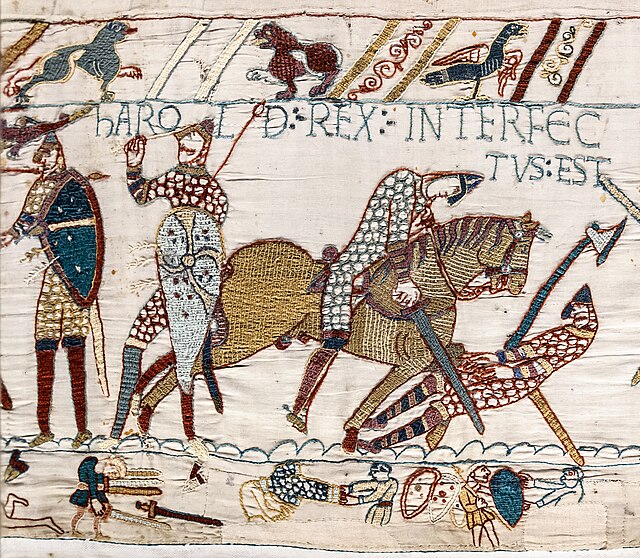
King Harold II was killed during the battle, though the exact manner of his death remains uncertain. A later tradition claims he was struck in the eye by an arrow, but historians debate this. Once Harold fell, English resistance collapsed, and William secured a decisive victory.
Impact and Legacy
The Battle of Hastings had lasting consequences for England. William was crowned King William I on Christmas Day 1066, marking the start of Norman rule. The new regime replaced much of the Anglo-Saxon nobility with Norman lords and introduced a new aristocratic culture.
The conquest also transformed English government, military organization, architecture, and language. Castles spread rapidly across the country as tools of control. Norman French became the language of the ruling class, influencing English vocabulary for centuries. The Domesday Book, commissioned in 1085, reflected the Normans’ drive to measure and manage their new kingdom.
For historians, the battle remains a turning point: not simply a change of king, but a deep political and cultural shift that shaped medieval England.
Did You Know?
- The famous Bayeux Tapestry is a major visual source for the Battle of Hastings, though it was likely created from a Norman perspective.
- The battle lasted most of the day, making it unusually long for a medieval engagement.
- Battle Abbey was later built on the site by William the Conqueror as an act of penance and commemoration.
- The exact location of King Harold II’s death on the battlefield is still uncertain.
- Although called the Battle of Hastings, the fighting probably took place about 7 miles away near present-day Battle.