> APOLLO 11 MOON LANDING
First crewed mission to land humans on the Moon, carrying Neil Armstrong, Buzz Aldrin, and Michael Collins to lunar orbit and back.
Overview
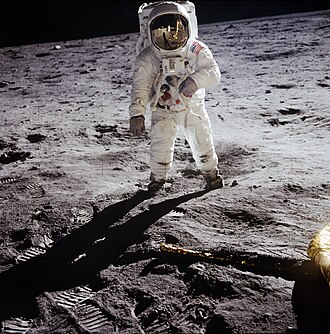
Apollo 11 was the American spaceflight that on July 20, 1969, landed the first humans on the Moon. Commander Neil Armstrong and Lunar Module pilot Buzz Aldrin spent more than two and a half hours walking on the lunar surface while command module pilot Michael Collins orbited above them in the spacecraft Columbia. The mission fulfilled President John F. Kennedy's 1961 pledge to land a man on the Moon and return him safely to Earth before the end of the decade, and it remains one of the signature technological achievements of the twentieth century.
The Space Race
The mission capped nearly a decade of intense competition with the Soviet Union. The USSR had shocked the United States by launching Sputnik in 1957 and by putting Yuri Gagarin into orbit in 1961. In response, Kennedy committed the country to a lunar landing, and NASA built the Apollo program — a massive public project that at its peak employed around four hundred thousand people and consumed more than four percent of the federal budget. Six prior Apollo missions, including Apollo 8 which orbited the Moon in late 1968 and Apollo 10 which tested the lunar module in lunar orbit, paved the way for a landing attempt.
The Mission
Apollo 11 launched from Kennedy Space Center in Florida on July 16, 1969, atop the 111-meter Saturn V rocket — still the most powerful rocket ever flown to successful operation. After a three-day transit to the Moon, Armstrong and Aldrin separated from the command module in the lunar lander Eagle and began their descent. They touched down at 20:17 UTC in the Sea of Tranquility, with only a handful of seconds of fuel remaining and a computer overloaded with program alarms that mission controllers had to override on the fly. Armstrong stepped onto the surface at 02:56 UTC on July 21, announcing, "That's one small step for man, one giant leap for mankind." Aldrin followed about nineteen minutes later. Together they planted the American flag, collected about twenty-two kilograms of lunar rock and soil, and set up scientific experiments before lifting off to rejoin Collins in orbit.
Legacy
The crew returned to Earth on July 24, splashing down in the Pacific Ocean. An estimated six hundred million people — about one-fifth of Earth's population at the time — watched the broadcast, making it the most-watched live event in history up to that point. Apollo 11's samples transformed our understanding of the Moon's origin, supporting the giant-impact hypothesis that the Moon formed from debris thrown off after a Mars-sized body struck early Earth. Five more successful lunar landings followed through 1972, but no human has returned to the Moon since. NASA's Artemis program, begun in the 2020s, aims to change that.
Did You Know?
- The Eagle had only about twenty-five seconds of fuel remaining when it landed.
- Michael Collins orbited alone in Columbia while the other two walked on the Moon.
- Armstrong and Aldrin left behind a plaque reading, "We came in peace for all mankind."
- Roughly six hundred million people watched the landing live on television.