> AMERICAN CIVIL WAR
The American Civil War was a defining conflict over union, slavery, and federal power that reshaped the United States.
Overview
The American Civil War was fought from 1861 to 1865 between the United States (the Union) and eleven Southern states that seceded to form the Confederate States of America. It remains the deadliest war in U.S. history. The conflict centered on slavery, states’ rights, and the future of the federal Union. By the war’s end, the Union had been preserved, slavery had been abolished, and the balance of power between the federal government and the states had shifted permanently.
The war began after the election of Abraham Lincoln in 1860, which convinced many slaveholding Southern leaders that their political power was under threat. In April 1861, Confederate forces fired on Fort Sumter in South Carolina, prompting Lincoln to call for troops and turning a political crisis into open war.
Background
The roots of the American Civil War stretched back decades. The expansion of the United States raised a recurring question: would new territories allow slavery? Political compromises, including the Missouri Compromise of 1820 and the Compromise of 1850, temporarily eased tensions but did not solve the issue. The Kansas-Nebraska Act of 1854 and violence in “Bleeding Kansas” showed that sectional conflict was deepening.
Economic and social differences also intensified the divide. The North developed a more industrial economy with growing cities and railroads, while the South relied heavily on agriculture and enslaved labor, especially in cotton production. Abolitionist activism increased in the North, while many white Southerners defended slavery as essential to their society and economy.
Key Moments
Early in the war, the Confederacy won several important battles, including First Bull Run in 1861. However, the Union’s larger population, stronger industrial base, and greater railroad network gave it long-term advantages. The war expanded across many fronts, from Virginia to the Mississippi River.
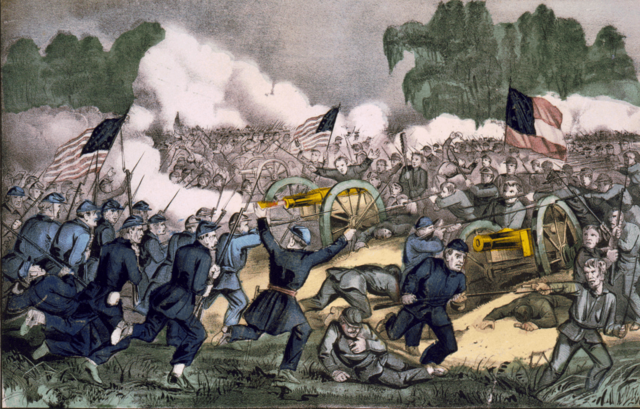
Two major turning points came in 1863. In July, the Union won the Battle of Gettysburg, halting Confederate General Robert E. Lee’s invasion of the North. That same month, General Ulysses S. Grant captured Vicksburg, giving the Union control of the Mississippi River and splitting the Confederacy.
Lincoln’s Emancipation Proclamation, issued on January 1, 1863, declared enslaved people in Confederate-held territory to be free. Though limited in immediate effect, it transformed the war into a fight against slavery and discouraged European powers from recognizing the Confederacy. Nearly 180,000 Black soldiers eventually served in the Union Army.
Impact and Legacy
The Civil War ended in 1865 after a series of Union victories and Lee’s surrender to Grant at Appomattox Court House in April. Days later, Lincoln was assassinated, casting a shadow over the Union victory. The Thirteenth Amendment, ratified in December 1865, formally abolished slavery in the United States.
The war’s legacy was immense. It preserved the United States as a single nation, ended legal slavery, and led to Reconstruction, a contentious effort to rebuild the South and define freedom and citizenship for formerly enslaved people. At the same time, unresolved racial injustice continued long after the war. The American Civil War remains central to understanding U.S. politics, civil rights, military history, and national identity.
Did You Know?
- More Americans died in the Civil War than in any other U.S. conflict.
- The Battle of Antietam in 1862 remains the bloodiest single day in American military history.
- Clara Barton, who later founded the American Red Cross, gained national attention for her Civil War relief work.
- The ironclad warships USS Monitor and CSS Virginia changed naval warfare during the conflict.
- General Robert E. Lee once commanded U.S. forces before resigning to join the Confederacy.