> BLACK DEATH
The Black Death was a devastating pandemic that killed millions across Eurasia and transformed medieval society.
Overview
The Black Death was one of the deadliest pandemics in world history. It swept across Europe, North Africa, and parts of Asia between 1346 and 1353, killing an estimated 25 to 50 million people in Europe alone, with many more deaths elsewhere. Most historians identify it as a major outbreak of plague caused by the bacterium Yersinia pestis, though the exact patterns of transmission remain debated in some regions.
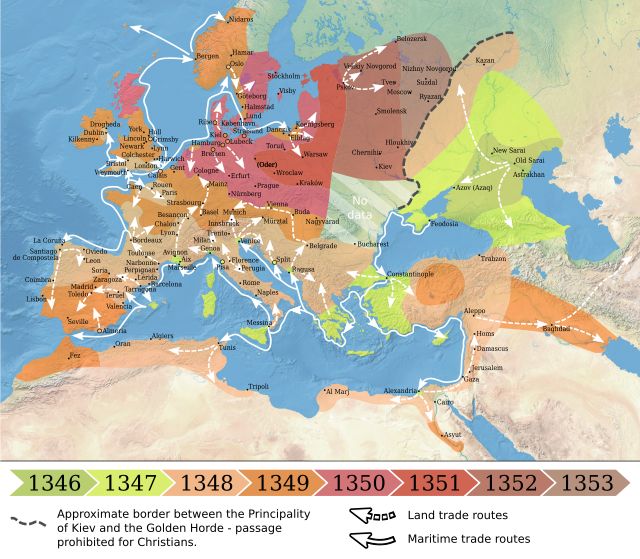
The disease spread rapidly along trade routes by land and sea. Merchant ships, caravans, and crowded towns helped carry infection from one community to another. Medieval people had no knowledge of bacteria, so they explained the catastrophe through religion, astrology, bad air, or divine punishment.
Background
Before the pandemic reached Europe, plague likely emerged from Central Asia and moved westward through expanding trade networks. The Mongol Empire had connected vast regions of Eurasia, allowing goods, people, and disease to travel more easily across long distances. By the mid-14th century, the infection had reached the Black Sea.
A commonly cited turning point came in 1346 during the siege of Kaffa, a Genoese trading port in Crimea. From there, Genoese ships are believed to have carried the disease into Mediterranean ports. In 1347, plague arrived in Sicily and then spread quickly to Italy, France, Spain, and beyond. By 1348 and 1349, it had reached England, the Low Countries, the German states, and Scandinavia.
The Event
The Black Death appeared in several forms, with bubonic plague being the most well known. Victims often developed swollen lymph nodes called buboes, along with fever, weakness, and vomiting. In some cases, the disease took pneumonic or septicemic forms, which could be even more lethal.
Mortality was shocking. In many cities and villages, a third or more of the population died within months. Burial grounds filled quickly, and normal social life broke down. Priests, physicians, laborers, and rulers all faced the same danger. Some families abandoned sick relatives, while others cared for them at great personal risk.
Efforts to stop the plague were limited. Authorities sometimes imposed quarantines, especially in port cities, and attempted to regulate movement. Venice later became famous for quarantine practices, requiring ships to wait before landing. Still, medieval medicine offered little effective treatment.
Impact and Legacy
The Black Death had enormous social and economic consequences. Labor shortages weakened the traditional feudal order in many parts of Europe. Surviving workers often demanded higher wages, and peasants in some regions gained greater bargaining power. Land use changed as farmland was abandoned or converted to pasture.
The pandemic also reshaped religion, culture, and public health. Many people turned to prayer, penitence, or popular religious movements, while others lost faith in institutions that seemed powerless. Artistic and literary themes increasingly reflected death, suffering, and the fragility of life.
The Black Death also fueled persecution. Jewish communities were falsely accused of poisoning wells and suffered massacres in several European towns. These attacks revealed how fear and misinformation can intensify human tragedy during a crisis.
In the long term, the pandemic encouraged more organized public health responses, including quarantine systems and urban sanitation measures. Its legacy remains central to the study of medieval history, epidemiology, and the history of global connections.
Did You Know?
- The term “Black Death” became common centuries after the pandemic; people living through it usually called it a pestilence or plague.
- Some cities lost more than half their population during the outbreak.
- The word “quarantine” comes from the Italian quaranta giorni, meaning “forty days.”
- The plague did not disappear after 1353; later outbreaks continued to strike Europe for centuries.