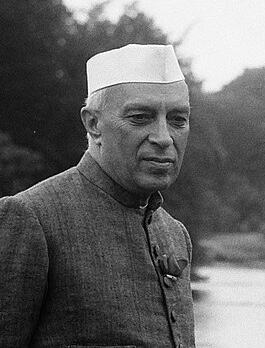
> JAWAHARLAL NEHRU
Indian independence leader and first prime minister of India, central to building the modern Indian state.
Overview
Jawaharlal Nehru was a leading figure in India’s struggle for independence and became the country’s first prime minister in 1947. He played a central role in shaping India’s early political institutions, economic planning, and international identity. For many, Nehru represents the founding vision of modern democratic India.
Early Life
Nehru was born in Allahabad in 1889 into a wealthy and politically active family. His father, Motilal Nehru, was an influential lawyer and nationalist. Jawaharlal received an elite education in England, attending Harrow and later Cambridge, before training in law. Despite this privileged background, he was deeply moved by colonial inequality and increasingly drawn into the Indian independence movement after returning home.
Independence Movement and Leadership
Nehru became a close associate of Mahatma Gandhi, though the two men sometimes differed in style and emphasis. Gandhi emphasized mass nonviolent protest and spiritual discipline, while Nehru often spoke in more modern, secular, and socialist terms. He was repeatedly imprisoned by British authorities for his role in anti-colonial campaigns. As independence approached, Nehru emerged as one of the most prominent leaders of the Indian National Congress. On August 15, 1947, he delivered his famous “Tryst with Destiny” speech as India became independent.
Prime Minister and Legacy
As India’s first prime minister, Nehru helped establish parliamentary democracy, expand higher education, and promote scientific and industrial development. He supported a mixed economy and became a major voice in the Non-Aligned Movement during the Cold War. Critics argue that some of his economic and foreign policy decisions had long-term costs, but his importance in building India’s institutions remains immense.
Did You Know?
- Nehru served as India’s first prime minister from 1947 until his death in 1964.
- His birthday, November 14, is celebrated as Children’s Day in India.
- He wrote influential books while imprisoned by the British.
- He was the father of future prime minister Indira Gandhi.