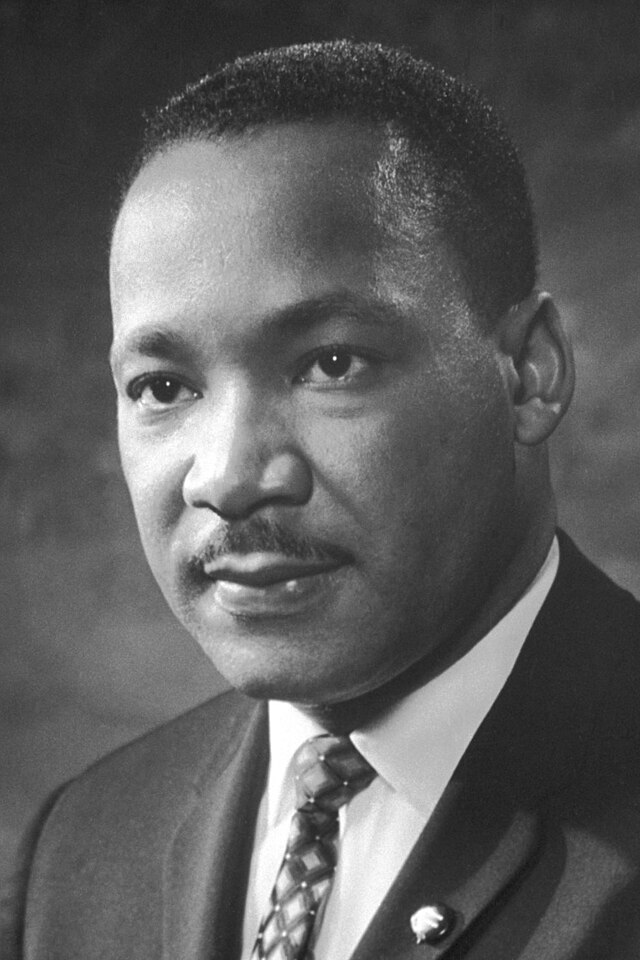
> MARTIN LUTHER KING JR.
American Baptist minister and civil rights leader whose nonviolent campaign reshaped U.S. law and the moral conscience of a nation.
Overview
Martin Luther King Jr. was the most recognizable leader of the American civil rights movement. Guided by Christian theology and the principles of nonviolent resistance, he organized boycotts, marches, and campaigns that dismantled legal segregation across the American South. His "I Have a Dream" speech, delivered at the 1963 March on Washington, became one of the defining moments of the twentieth century.
Early Life and Education
King was born in Atlanta, Georgia, in 1929 to a family deeply rooted in the Black Baptist church. His father served as pastor of Ebenezer Baptist Church, and young Martin grew up in a household that combined religious conviction with an insistence on human dignity. He entered Morehouse College at just fifteen, then studied theology at Crozer Theological Seminary, and completed a doctorate in systematic theology at Boston University. It was during these years that he first encountered Mahatma Gandhi's writings on satyagraha, which would become the strategic core of his later activism.
Civil Rights Leadership
King's public leadership began in 1955, when he was chosen to head the Montgomery Bus Boycott following Rosa Parks's arrest. The 381-day boycott ended with a Supreme Court ruling against bus segregation and made King a national figure. He co-founded the Southern Christian Leadership Conference to coordinate nonviolent campaigns, leading efforts in Albany, Birmingham, Selma, and Chicago. His 1963 "Letter from Birmingham Jail" became a foundational text on the moral duty to resist unjust laws. That same year, he addressed more than 250,000 people at the Lincoln Memorial with his "I Have a Dream" speech, helping build the political pressure that produced the Civil Rights Act of 1964 and the Voting Rights Act of 1965.
Legacy
King was awarded the Nobel Peace Prize in 1964 at the age of thirty-five. In his final years, he broadened his focus to economic justice and opposition to the Vietnam War, drawing sharper criticism but insisting that peace, racism, and poverty were inseparable. He was assassinated in Memphis on April 4, 1968, while supporting a strike of sanitation workers. His birthday is now a U.S. federal holiday, and his speeches and writings remain among the most studied documents in American public life.
Did You Know?
- King entered college at age fifteen through an early-admission program.
- The "I Have a Dream" portion of his 1963 speech was partly improvised.
- He was the youngest male Nobel Peace laureate at the time of his award.
- His "Letter from Birmingham Jail" was written on the margins of a newspaper.