> GALILEO GALILEI
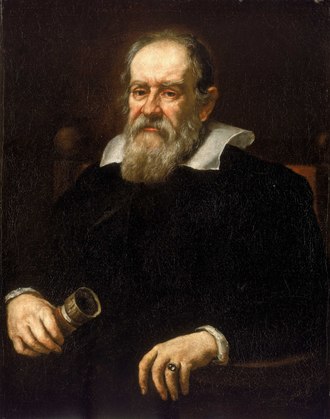
Italian astronomer, physicist, and mathematician whose observations helped transform science and support heliocentrism.
Overview
Galileo Galilei was an Italian astronomer, physicist, and mathematician widely known as one of the central figures of the Scientific Revolution. Born in Pisa in 1564, he made major advances in the study of motion, mechanics, and astronomy. Galileo is especially famous for improving the telescope and using it to observe the heavens in ways that challenged traditional ideas about the universe.
His work provided powerful evidence for the heliocentric model, which placed the Sun rather than the Earth at the center of the solar system. At a time when many scholars still followed ancient authorities, Galileo insisted that observation, experiment, and mathematics should guide scientific understanding. This approach helped shape modern science.
Early Life
Galileo was born on February 15, 1564, in Pisa, in the Duchy of Florence. His father, Vincenzo Galilei, was a musician and thinker who encouraged questioning accepted ideas. Galileo first studied at the University of Pisa, where he began in medicine but soon turned to mathematics and natural philosophy.
As a young scholar, he became interested in motion and mechanical principles. He later taught mathematics in Pisa and Padua. His years at the University of Padua were especially productive, allowing him to conduct research, teach students, and build his reputation as an inventive and original thinker.
Scientific Achievements
Galileo made important contributions to physics before his astronomical fame. He studied falling bodies and argued that objects do not fall at speeds determined solely by their weight, as Aristotle had taught. He also explored inertia and acceleration, laying groundwork later used by Isaac Newton.
In 1609, after hearing of a Dutch spyglass, Galileo built improved telescopes of his own. With these instruments, he made remarkable discoveries. He observed mountains and craters on the Moon, showing that it was not a perfect heavenly sphere. He discovered four large moons orbiting Jupiter, proving that not everything revolved around the Earth. He also observed the phases of Venus, which strongly supported the heliocentric theory associated with Nicolaus Copernicus.
Galileo published many of these findings in Sidereus Nuncius (1610), a work that quickly made him famous across Europe. His observations of sunspots further weakened the older idea that the heavens were unchanging and perfect.
Conflict and Trial
Galileo’s support for heliocentrism brought him into conflict with Church authorities. In the early 17th century, the Roman Catholic Church regarded the Copernican model with suspicion, especially when presented as physical truth rather than mathematical convenience.
In 1632, Galileo published Dialogue Concerning the Two Chief World Systems, which compared the Ptolemaic and Copernican views. Although written as a discussion, the book clearly favored heliocentrism. As a result, Galileo was tried by the Roman Inquisition in 1633. He was found strongly suspect of heresy and forced to recant his support for the Sun-centered system. He spent the rest of his life under house arrest.
Even during this period, Galileo continued to work. His later book, Two New Sciences (1638), summarized decades of research on motion and materials and became a foundational text in physics.
Legacy
Galileo died in 1642, but his influence only grew after his death. He is often called the “father of modern science” because he joined careful observation with mathematical analysis and experimentation. His work changed astronomy, advanced physics, and encouraged a new scientific method based on evidence rather than authority.
Today, Galileo Galilei remains a symbol of scientific inquiry, intellectual courage, and the transition from medieval thought to modern science.
Did You Know?
- Galileo did not invent the telescope, but he greatly improved it and used it for groundbreaking astronomical observations.
- The four largest moons of Jupiter that he discovered are now called the Galilean moons: Io, Europa, Ganymede, and Callisto.
- Galileo became blind late in life, yet he continued his scientific work with the help of students and assistants.
- He was a skilled writer whose Italian prose helped make complex scientific ideas accessible to a wider audience.