> LEONARDO DA VINCI
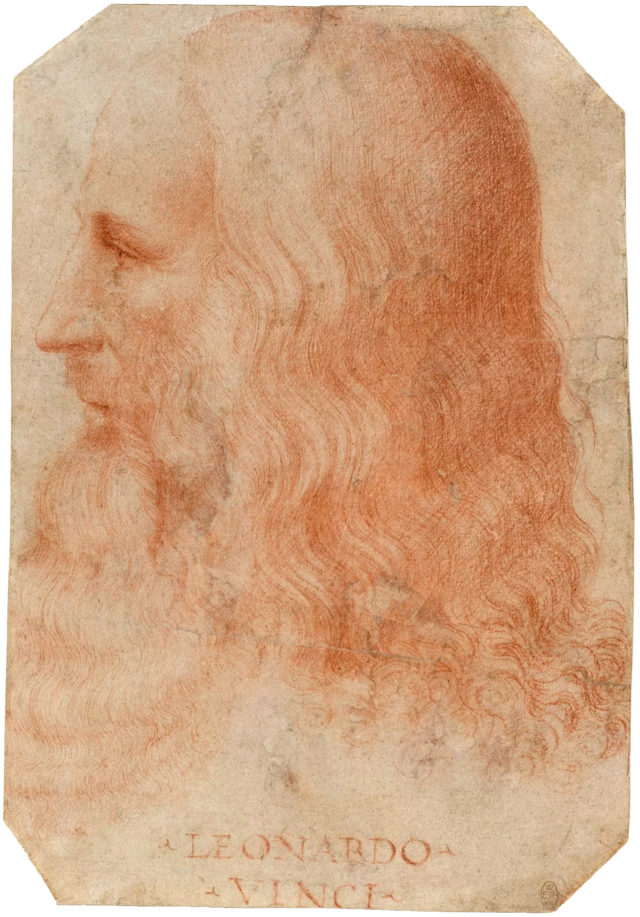
Italian Renaissance polymath — painter, engineer, anatomist, and inventor whose notebooks anticipated ideas centuries ahead of his time.
Overview
Leonardo da Vinci was an Italian painter, draftsman, engineer, scientist, and inventor whose range of interests made him the archetype of the "Renaissance man." He produced two of the most famous paintings in Western art — the Mona Lisa and The Last Supper — while filling thousands of notebook pages with anatomical studies, engineering sketches, architectural plans, and scientific observations. His insatiable curiosity and the sheer breadth of his investigations still shape how we imagine creative genius today.
Early Life and Training
Leonardo was born in 1452 in or near the Tuscan town of Vinci, the illegitimate son of a notary, Ser Piero, and a peasant woman named Caterina. Because of his illegitimacy he was barred from the university and from conventional notarial or medical careers, which may have freed him to pursue a broader path. Around the age of fourteen he was apprenticed to the sculptor and painter Andrea del Verrocchio in Florence, a workshop that also trained Botticelli and Ghirlandaio. Leonardo's gifts were recognized quickly — legend holds that Verrocchio put down his brush in awe after seeing his young apprentice paint an angel for the Baptism of Christ.
Painting and Notebooks
Leonardo painted relatively few pictures — about fifteen survive — but each pushed the medium forward. The Last Supper (1495–1498) reimagined a traditional religious subject as a moment of intense psychological drama. The Mona Lisa (c. 1503–1519) refined his technique of sfumato, layering translucent glazes to create soft, atmospheric transitions. His most revolutionary work, however, was often unseen in his lifetime: his notebooks. Written in his trademark mirror script, they contain studies of human anatomy based on dissections he performed himself, designs for flying machines, parachutes, armored vehicles, and water pumps, as well as observations on geology, optics, botany, and the turbulence of flowing water.
Later Years and Legacy
Leonardo worked for some of the most powerful patrons of his era — the Sforza of Milan, Cesare Borgia, and Pope Leo X — and spent his final years as a guest of King Francis I of France, living at the Château du Clos Lucé near Amboise. He died there in 1519 at the age of sixty-seven. Because most of his notebooks were unpublished for centuries, his scientific insights had little direct influence on his contemporaries. Rediscovered and translated in the nineteenth and twentieth centuries, they revealed a mind that had anticipated ideas later developed in aerodynamics, civil engineering, and biomechanics, cementing Leonardo's reputation as one of the most inventive thinkers in human history.
Did You Know?
- Leonardo wrote most of his notes in mirror script, readable only when held up to a reflection.
- He dissected around thirty human corpses to study anatomy.
- Fewer than twenty paintings are firmly attributed to him.
- He carried the Mona Lisa with him to France and it stayed with him until his death.