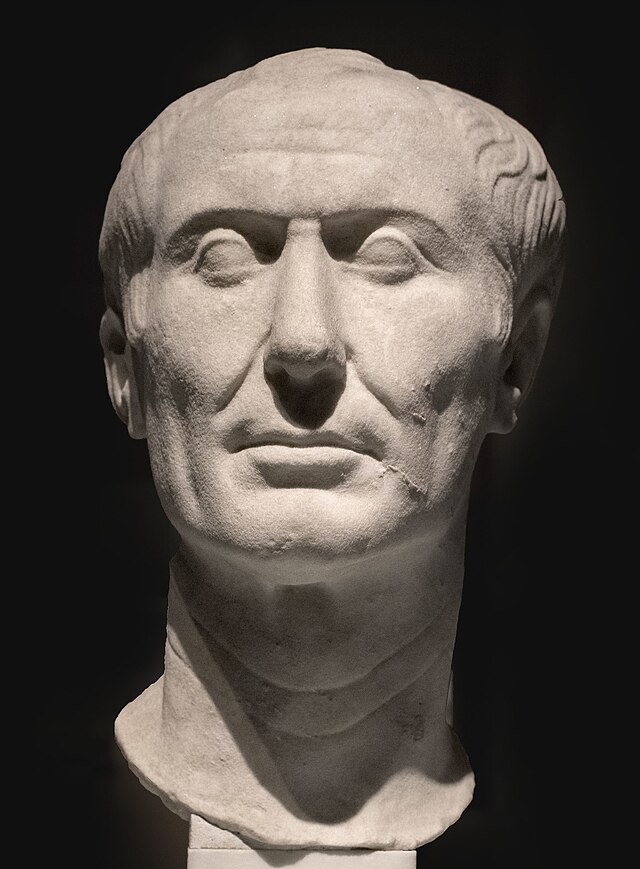
> JULIUS CAESAR
Roman general, statesman, and dictator whose conquests and political reforms helped end the Roman Republic and reshape the ancient world.
Overview
Gaius Julius Caesar was a Roman general, politician, and writer whose career marked the turning point between the Roman Republic and the Roman Empire. He extended Roman rule across Gaul, seized power in a civil war, and ruled as dictator of Rome until his assassination on the Ides of March in 44 BCE. Through his political heir Octavian, later known as Augustus, Caesar's legacy became the foundation of more than five centuries of Roman imperial rule.
Early Career
Caesar was born in 100 BCE to a patrician family that traced its mythical descent from the goddess Venus. Although his family was old and noble, it was neither wealthy nor politically powerful. He rose through Rome's traditional political ladder — quaestor, aedile, praetor, and finally consul in 59 BCE — by combining oratorical skill, lavish spending on public games, and shrewd alliances. The most important of these was the so-called First Triumvirate, an informal pact with the wealthy Marcus Licinius Crassus and the brilliant general Pompey the Great. This coalition dominated Roman politics for most of the 50s BCE.
The Gallic Wars and Civil War
As governor of Gaul from 58 BCE, Caesar fought an extended series of campaigns that he chronicled in his clear, terse Commentarii de Bello Gallico. Over nine years he subdued the Gallic tribes, invaded Britain twice, and brought a vast new province under Roman control. His success — and the immense wealth and army loyalty it produced — alarmed his political rivals in Rome. In 49 BCE, ordered to disband his legions and return as a private citizen, he instead crossed the Rubicon River with a single legion, famously declaring alea iacta est ("the die is cast"). The civil war that followed carried him to victory over Pompey at Pharsalus in 48 BCE and left him the unchallenged master of Rome.
Dictatorship and Assassination
As dictator, Caesar introduced reforms that outlasted him: he overhauled the Roman calendar (the Julian calendar that remained in use for sixteen centuries), expanded Roman citizenship, settled veterans in new colonies, and restructured debts. In February of 44 BCE he was named dictator perpetuo — dictator for life. A month later, on March 15, a group of senators led by Marcus Junius Brutus and Gaius Cassius Longinus stabbed him to death at a meeting of the Senate, hoping to restore the Republic. Instead, their act plunged Rome into another round of civil wars, which ended only when Caesar's grand-nephew and adopted son Octavian became the first Roman emperor.
Did You Know?
- Caesar's given name, Caesar, became the title used by later Roman and European monarchs — Kaiser and Tsar both derive from it.
- He was stabbed twenty-three times by as many as sixty conspirators.
- The Julian calendar he introduced shaped Western timekeeping for over 1,600 years.
- Caesar was an accomplished author, and his writings are still read in Latin classrooms worldwide.