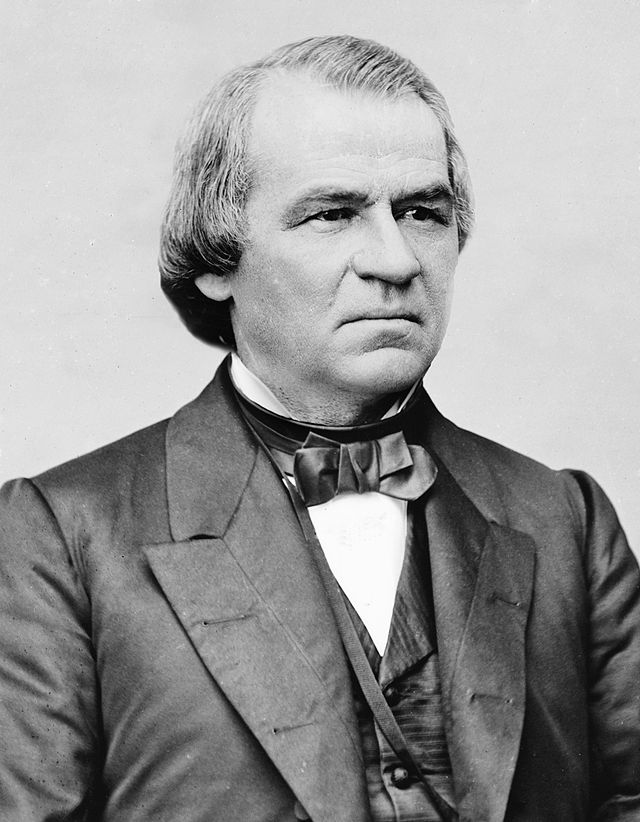
> ANDREW JOHNSON
17th U.S. president who led the country after Lincoln’s assassination and became the first president to be impeached.
Overview
Andrew Johnson was the 17th president of the United States and took office in 1865 after the assassination of Abraham Lincoln. He led the country during the opening phase of Reconstruction, a period marked by enormous tension over the future of the South and the rights of formerly enslaved people. His presidency remains one of the most controversial in American history.
Early Life
Johnson was born in poverty in Raleigh, North Carolina, in 1808. He received little formal education and worked as a tailor in his youth. Despite these disadvantages, he entered politics and gradually built a career as a local official, congressman, governor, and senator from Tennessee. Johnson presented himself as a defender of ordinary white workers and eventually became one of the few Southern senators who remained loyal to the Union when the Civil War began.
Presidency and Reconstruction
Lincoln chose Johnson as vice president in 1864 to show national unity during wartime. After Lincoln’s death, Johnson inherited the challenge of rebuilding the nation. He favored a lenient approach toward former Confederate states, allowing many ex-Confederate leaders to return to power quickly. At the same time, Southern states passed Black Codes that severely restricted the freedom of newly emancipated African Americans. Johnson repeatedly clashed with Congress, especially the Radical Republicans, who wanted stronger federal protection for civil rights and a tougher Reconstruction policy.
Impeachment and Historical Reputation
Johnson vetoed major Reconstruction legislation, including civil rights measures, though Congress overrode some of his vetoes. Conflict peaked when he violated the Tenure of Office Act by trying to remove Secretary of War Edwin Stanton. The House of Representatives impeached him in 1868, making him the first U.S. president to face impeachment. He avoided removal by a single Senate vote. Today, historians generally rank Johnson poorly because his policies undermined efforts to build a more just postwar South.
Did You Know?
- Johnson was the only Southern senator who stayed loyal to the Union after secession.
- He was the first president of the United States to be impeached.
- He had almost no formal schooling and taught himself many skills.
- His conflict with Congress shaped later debates about presidential power.