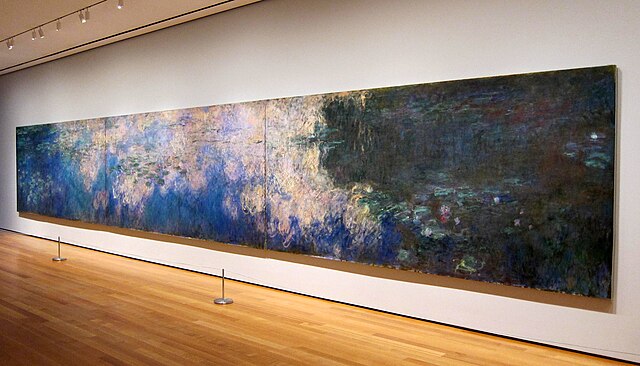
> WATER LILIES
Claude Monet’s celebrated series of paintings of his garden pond, exploring light, color, reflection, and modern painting.
Overview
Water Lilies is the name commonly given to Claude Monet’s famous series of paintings inspired by the pond in his garden at Giverny. Across dozens of canvases, Monet returned again and again to floating lilies, reflections, sky, and changing light. The series became one of the defining achievements of Impressionism and a major bridge toward modern abstraction.
Creation and Background
Monet created his water lily paintings over several decades, especially in the later part of his life. At Giverny, he carefully designed a garden with a Japanese bridge, pond, and water plants that became both his refuge and his artistic laboratory. Rather than painting a single fixed scene, he explored how atmosphere changed from hour to hour and season to season. This made the subject ideal for his lifelong interest in light and perception.
Style and Technique
In the Water Lilies series, Monet gradually moved away from traditional perspective and clear horizon lines. Many canvases focus almost entirely on the water’s surface, where reflections of clouds, trees, and flowers merge into shimmering patterns of color. This gave the paintings a strikingly immersive quality. Loose brushwork, subtle tonal variation, and repeated observation allowed Monet to transform a garden pond into a vast field of visual experimentation.
Legacy
The Water Lilies paintings had a lasting impact on 20th-century art. Later painters admired their scale, atmosphere, and near-abstract handling of space. Today, the series is seen not only as a masterpiece of Impressionism but also as an important step toward modern art’s freedom in color and composition.
Did You Know?
- Monet painted more than 200 works connected to his water lily theme.
- His garden at Giverny was designed partly as a subject for painting.
- Some of the largest Water Lilies canvases are displayed in Paris’s Musée de l’Orangerie.
- The series influenced later abstract and color-focused painters.