> MOAI OF EASTER ISLAND
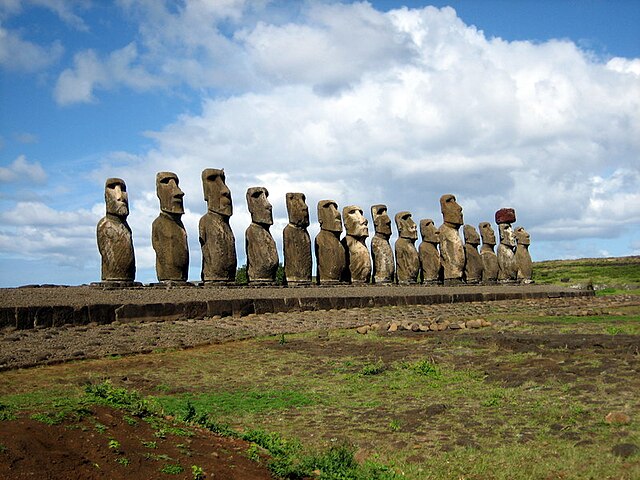
Nearly 900 monumental stone figures carved by the Rapa Nui people of Easter Island, among the most enigmatic sculptures of the ancient world.
Overview
The moai are monumental human-figure sculptures carved between roughly 1250 and 1500 CE by the Rapa Nui people on Easter Island, known in the Polynesian language as Rapa Nui. Nearly nine hundred of them survive, ranging from about two meters to around ten meters tall, with the largest ever carved approaching twenty-one meters and never raised. They are among the most recognizable archaeological monuments in the world and a powerful symbol of the extraordinary reach of Polynesian voyaging across the Pacific.
Who Built Them
Rapa Nui is one of the most isolated inhabited places on Earth, roughly 3,700 kilometers west of mainland Chile and 2,000 kilometers east of the nearest Polynesian island. Polynesian navigators reached it sometime between the tenth and thirteenth centuries CE after one of the longest voyages of discovery in human history. Over the next several centuries their descendants built a complex society organized around lineages, each associated with a stretch of coastline and with ceremonial platforms known as ahu. The moai, carved to honor ancestors and to anchor the mana, or spiritual authority, of a lineage, were placed atop these platforms facing inland so they could watch over the villages they protected.
Carving and Transport
Almost all of the moai were quarried from the soft volcanic tuff of Rano Raraku, an extinct volcano near the island's eastern end. Sculptors carved the figures horizontally out of the rock, then levered them free, slid them down the outer slopes, and set them upright before transporting them to their final platforms. How the statues — the heaviest weighing as much as eighty tons — were moved across the island was long a mystery. Oral tradition said the moai walked, and experimental archaeologists have shown that standing statues can indeed be rocked forward with ropes, producing a walking motion, which fits both the oral record and wear marks along the roads leading out of Rano Raraku.
Decline and Rediscovery
By the time European ships arrived in the early eighteenth century, moai construction had already stopped and many statues had been toppled during internal conflicts. Deforestation, erosion, and later the catastrophic effects of European slave raids and introduced diseases reduced the Rapa Nui population to around one hundred and ten people by 1877. In the twentieth century, archaeologists and the Rapa Nui community itself began restoring fallen statues, re-erecting them on their platforms, and documenting the vast unfinished figures still at Rano Raraku. The island became a UNESCO World Heritage Site in 1995, and the moai are now protected through a national park managed in partnership with the Rapa Nui community.
Did You Know?
- Around nine hundred moai have been documented on Rapa Nui.
- Many moai once had large hats or topknots of red stone known as pukao.
- Experiments suggest the statues were "walked" upright to their destinations.
- An unfinished moai still attached to the rock at Rano Raraku would have stood nearly twenty-one meters tall.