> AMERICAN GOTHIC
Grant Wood’s American Gothic is a landmark 1930 painting that became one of the most recognizable images in American art.
Overview
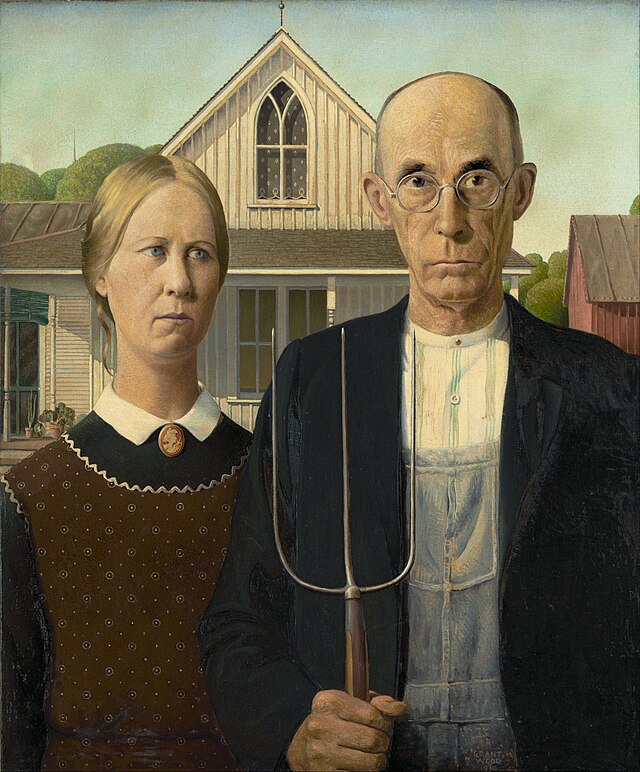
American Gothic is a 1930 painting by American artist Grant Wood and one of the most famous artworks in United States history. The painting shows two figures standing in front of a white house with a pointed Gothic-style window: a stern-looking farmer holding a pitchfork and a woman beside him, often mistaken for his wife. Wood intended them to represent a father and daughter. Today, the work is held by the Art Institute of Chicago, where it remains a major attraction.
Created during the early years of the Great Depression, American Gothic quickly became a cultural symbol. Viewers have long debated whether the painting celebrates rural American values such as hard work and discipline, or whether it gently satirizes small-town seriousness. Its ambiguity is one reason it has remained so influential.
Creation
Grant Wood was born in Iowa and became closely associated with Midwestern regionalism, a movement that focused on American subjects and local landscapes rather than European trends. In 1930, Wood saw a small house in Eldon, Iowa, built in the Carpenter Gothic style. He was struck by its narrow upper window and decided to create a painting around the kind of people he imagined living there.
For the models, Wood used his sister, Nan Wood Graham, and his dentist, Dr. Byron McKeeby. Although many assumed the pair were husband and wife, Wood said they were meant to be daughter and father. He carefully arranged their clothing and poses to match the severe vertical lines of the house and pitchfork. After completing the painting, he entered it in a competition at the Art Institute of Chicago, where it won a bronze medal and cash prize. The museum soon acquired it.
Style and Technique
American Gothic is known for its precision, balance, and strong design. The composition is tightly organized, with repeated vertical elements linking the pitchfork, the seams in the man’s overalls, the house siding, and the Gothic window. These details create a formal, almost rigid structure that reinforces the painting’s serious mood.
Wood’s technique combines realism with stylization. The faces, clothing, and objects are painted with careful clarity, yet the overall effect is more symbolic than photographic. The figures appear still and controlled, almost iconic. This gives the painting a timeless quality and helps explain why it has been interpreted in different ways over the decades.
The work is often associated with Regionalism, an American art movement of the 1930s that emphasized rural life and recognizable local scenes. Unlike modernist abstraction, Regionalist artists aimed to present accessible subjects to a broad public. American Gothic became one of the clearest examples of that approach.
Legacy
Few American paintings have had the cultural reach of American Gothic. Almost immediately after its debut, it sparked discussion in newspapers and among critics. Some rural Americans disliked what they saw as an unflattering portrayal, while others admired its honesty and strength. Over time, the image became a shorthand for the American Midwest, traditional values, and rural identity.
Its impact extends far beyond the museum world. American Gothic has been endlessly parodied in photography, film, cartoons, advertising, and political satire. These recreations usually keep the basic composition—the two figures, the pitchfork, and the house—because the original image is so widely recognized. This lasting visibility has made Grant Wood’s painting a cornerstone of American visual culture and an essential work in the history of 20th-century art.
Did You Know?
- Grant Wood based the house in American Gothic on a real home in Eldon, Iowa.
- The woman in the painting is not the farmer’s wife; Wood said she was his daughter.
- Wood used his sister and his dentist as the painting’s models.
- The painting won a prize at the Art Institute of Chicago in 1930, and the museum later purchased it.
- American Gothic is one of the most frequently parodied images in American art.