> DAVID (MICHELANGELO)
Michelangelo’s David is a Renaissance marble masterpiece symbolizing civic pride, artistic skill, and the idealized human form.
Overview
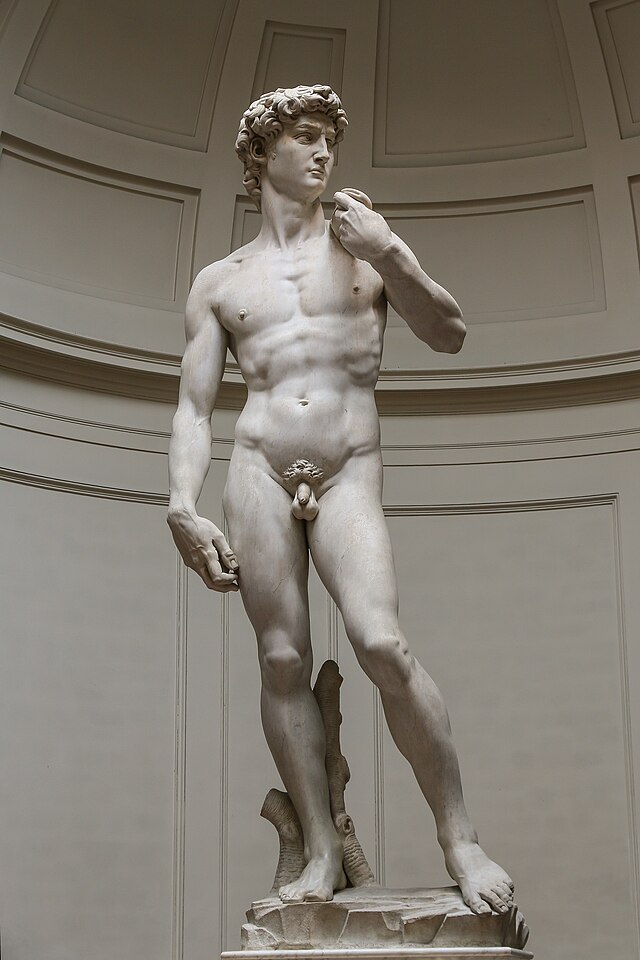
David by Michelangelo is one of the most famous sculptures of the Italian Renaissance and a defining work of Western art. Carved in marble between 1501 and 1504, the statue depicts the biblical hero David just before his battle with Goliath. Standing over 5 meters (17 feet) tall, it was created in Florence, where it quickly became a symbol of republican strength, vigilance, and civic pride.
Unlike earlier depictions that showed David after victory, Michelangelo chose the tense moment before action. The figure’s alert expression, focused gaze, and poised stance convey psychological intensity rather than triumph. This approach helped make David a landmark of Renaissance sculpture, admired for both its technical brilliance and emotional power.
Creation
Michelangelo was commissioned to carve the statue from a large block of Carrara marble that had already been worked on unsuccessfully by other sculptors. The block had been abandoned for years and was considered difficult to use because of its narrow shape and flaws. Michelangelo, still in his twenties, accepted the challenge and transformed it into one of the greatest masterpieces in art history.
Originally, David was intended for the roofline of Florence Cathedral. However, once completed, city officials recognized its extraordinary quality and chose a more prominent public location. In 1504, the statue was installed in the Piazza della Signoria, outside the Palazzo Vecchio, the political heart of Florence. There it stood as a public image of the city’s ideals and resistance to powerful enemies.
Style and Technique
Michelangelo’s David reflects the Renaissance fascination with classical antiquity, anatomy, and human potential. The sculpture is carved in contrapposto, a pose in which the body’s weight rests on one leg, creating a natural but dynamic balance. This gives the figure both stillness and latent movement.
The anatomy is highly detailed, from the tense neck muscles to the veins in the hands and arms. Michelangelo emphasized parts of the body, especially the hands and head, possibly to heighten expressive impact and compensate for the statue’s intended high placement. The result is an idealized but convincing human form that combines observation of nature with artistic interpretation.
The statue also stands out for its psychological realism. David’s furrowed brow and concentrated stare suggest calculation and courage. This focus on inner resolve, rather than physical action alone, marked a major artistic achievement.
Legacy
Over the centuries, David has become a universal symbol of beauty, strength, and artistic excellence. It represents not only the biblical hero but also Florence’s self-image during a period of political uncertainty. For many viewers, the statue embodies the Renaissance belief in human dignity and capability.
To protect the original from weathering, the statue was moved in 1873 to the Galleria dell’Accademia in Florence, where it remains today. A replica now stands in its historic outdoor location. David continues to attract millions of visitors and remains central to discussions of Renaissance art, sculpture, and Michelangelo’s legacy.
Did You Know?
- Michelangelo began carving David when he was only 26 years old.
- The marble block used for the statue had been abandoned for about 25 years before Michelangelo took over.
- David was originally planned for Florence Cathedral, not for a public square.
- The original statue is housed in the Galleria dell’Accademia in Florence, while a replica stands in Piazza della Signoria.