> LAS MENINAS
Diego Velázquez’s Las Meninas is a landmark Baroque painting famed for its complex composition, court portraiture, and visual mystery.
Overview
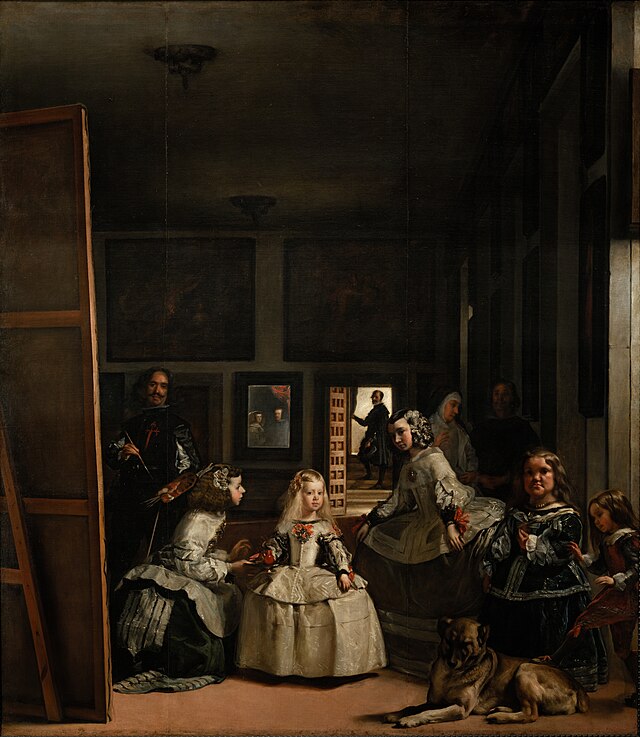
Las Meninas is one of the most studied and celebrated paintings in Western art. Created in 1656 by Diego Velázquez, court painter to King Philip IV of Spain, it is housed in the Museo del Prado in Madrid. The large canvas presents a scene inside the royal Alcázar of Madrid, showing the young Infanta Margaret Teresa surrounded by her attendants, or meninas, along with dwarfs, a dog, a chaperone, and Velázquez himself at work.
The painting is famous not only as a royal portrait but also as a sophisticated meditation on seeing, representation, and status. Viewers are drawn into the scene by the placement of figures, the mirror at the back of the room, and the uncertain identity of the painting’s true subject. For historians, Las Meninas offers a rare glimpse into the culture, hierarchy, and self-image of the Spanish Habsburg court.
Creation
Velázquez painted Las Meninas late in his career, after years of service to Philip IV. By 1656 he had developed a remarkably confident style and enjoyed unusual prestige for an artist at court. The work was created during Spain’s Siglo de Oro, or Golden Age, a period of major achievements in painting, literature, and theater despite political and economic strains in the empire.
The composition likely depicts a moment in the artist’s studio within the Alcázar. At the center stands the Infanta Margaret Teresa, daughter of Philip IV and Mariana of Austria. Her attendants kneel and stand around her, while Velázquez appears at the left before a large canvas. In the background, a mirror reflects the king and queen, suggesting that they stand where the viewer is positioned. This device turns the audience into participants and raises enduring questions about perspective and presence.
Style and Technique
The painting is a masterpiece of Baroque art, yet its naturalism feels strikingly modern. Velázquez used loose but controlled brushwork, especially in clothing, hair, and shimmering light, allowing details to emerge at a distance rather than through hard outlines. This technique gives the scene movement and atmospheric depth.
Light plays a central role. It enters from the right, illuminating the Infanta and creating a hierarchy of attention, while the dimmer rear space draws the eye toward the open doorway where José Nieto appears in silhouette. The room feels believable and lived-in, but it is also carefully staged to guide the viewer’s gaze.
Another key feature is the painting’s layered spatial logic. The artist, the royal couple, the reflected image, and the viewer all occupy interlocking positions. This complexity has made Las Meninas central to discussions of illusion, authorship, and the role of the spectator in art.
Legacy
Las Meninas has had a lasting influence on art history and modern visual culture. It was admired by later painters such as Francisco Goya and Édouard Manet, who saw in Velázquez a master of painterly freedom. In the 20th century, Pablo Picasso created an entire series of reinterpretations of Las Meninas, proving its continuing power as a source of experimentation.
Scholars also value the work as a document of court life and as a statement about the status of the artist. Velázquez places himself prominently among the royals and attendants, suggesting that painting was an intellectual and noble profession. Today, Las Meninas remains a cornerstone of the Prado and a defining example of Spanish Baroque painting.
Did You Know?
- Las Meninas means “The Ladies-in-Waiting” in Spanish, referring to the attendants around the Infanta.
- The red cross on Velázquez’s chest represents the Order of Santiago; it may have been added after he received the honor in 1659.
- The original setting, the Alcázar of Madrid, was destroyed by fire in 1734.
- Pablo Picasso produced 58 works inspired by Las Meninas in 1957.
- The painting’s large scale measures roughly 318 cm by 276 cm (about 10.4 by 9 feet).