> GIRL WITH A PEARL EARRING
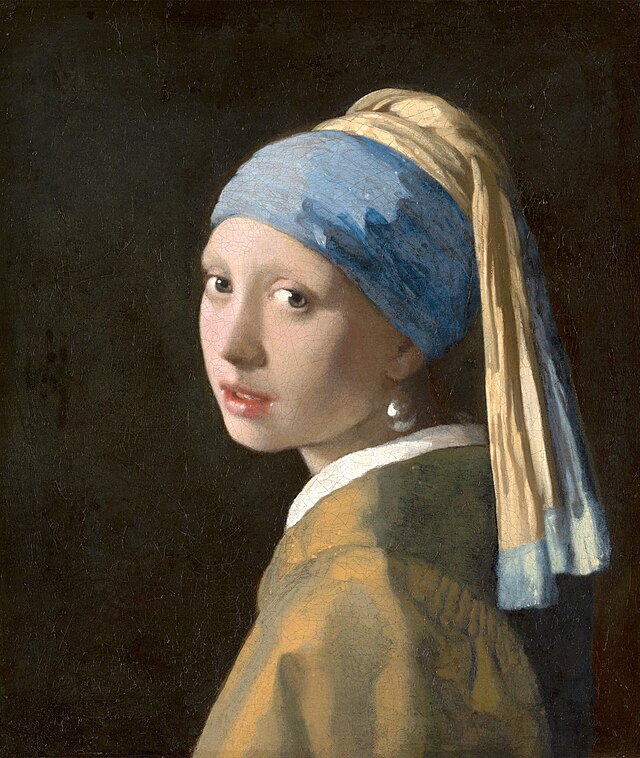
Johannes Vermeer’s Girl with a Pearl Earring is a celebrated Dutch Golden Age painting known for its luminous light and enigmatic gaze.
Overview
Girl with a Pearl Earring is one of the most famous paintings of the Dutch Golden Age. Created around 1665 by Johannes Vermeer, the work shows a young woman turning toward the viewer, her lips slightly parted and her eyes catching the light. The painting is housed in the Mauritshuis in The Hague and is often called the “Mona Lisa of the North” because of its quiet mystery and universal appeal.
Rather than a formal portrait, the work is generally understood as a tronie, a Dutch type of painting that depicted an expressive face or character in costume. The sitter’s blue and yellow turban, exotic at the time, and the oversized pearl earring add drama and visual focus. Vermeer used a dark, nearly featureless background to make the figure appear strikingly immediate.
Creation
Johannes Vermeer worked in Delft during the 17th century, a period of remarkable artistic and commercial growth in the Dutch Republic. Although he painted relatively few works, his reputation rests on his exceptional handling of light, color, and intimate interior scenes. Girl with a Pearl Earring belongs to the middle of his career, when he was producing some of his most refined paintings.
The identity of the girl remains unknown. There is no confirmed record naming the model, which has contributed to the painting’s enduring intrigue. Some scholars have suggested she may have been a family member or an imagined type rather than a specific individual. Because tronies were not meant to be literal likenesses, the mystery is consistent with the genre.
Style and Technique
Vermeer’s technique in Girl with a Pearl Earring demonstrates extraordinary control. The composition is simple but highly effective: the girl is shown in half-length, turned over her shoulder, creating a sense of motion and immediacy. Her face is softly modeled by light, while the turban’s vivid ultramarine and the warm yellow fabric create a rich color contrast.
The pearl itself is painted with remarkable economy. It is not described in detailed outline; instead, Vermeer used subtle highlights and tonal shifts to suggest its reflective surface. This approach gives the earring a luminous quality without heavy detail. The painting’s realism is balanced by idealization, which helps explain why the image feels both intimate and timeless.
Vermeer’s use of light is central to the work’s impact. The highlights on the girl’s eyes, lips, and earring guide the viewer’s attention and create a lifelike presence. His soft transitions and careful layering of paint contribute to the painting’s quiet atmosphere.
Legacy
For much of history, Vermeer was less famous than he is today, but interest in his work grew strongly in the 19th and 20th centuries. Girl with a Pearl Earring became one of his best-known paintings and is now a global icon of European art. Its popularity has been strengthened by exhibitions, scholarly study, and modern adaptations in literature and film.
The painting also plays an important role in discussions of Dutch art, portraiture, and the tronie tradition. Its combination of technical brilliance and unanswered questions continues to attract visitors, historians, and art lovers. Today, it remains a key example of how a small-scale 17th-century artwork can achieve worldwide recognition.
Did You Know?
- Girl with a Pearl Earring is usually classified as a tronie, not a conventional commissioned portrait.
- The famous “pearl” may not be a real pearl at all; some scholars think it could be polished metal or a glass ornament.
- Vermeer used expensive pigments, including natural ultramarine, made from lapis lazuli, for the blue turban.
- The painting is part of the collection of the Mauritshuis museum in The Hague, Netherlands.