> CAMPBELL'S SOUP CANS
Andy Warhol's Campbell's Soup Cans transformed everyday packaging into a landmark work of Pop Art in 1962.
Overview
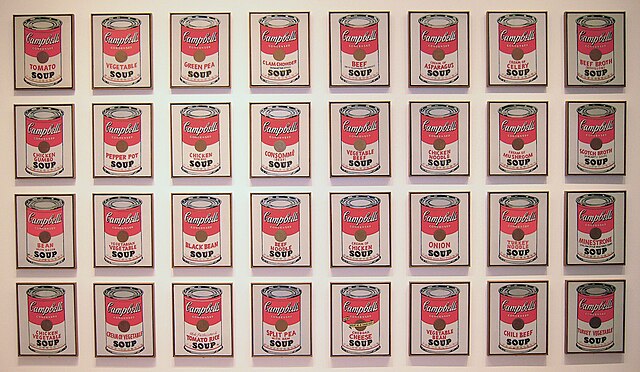
Campbell's Soup Cans is a 1962 artwork by American artist Andy Warhol and one of the most famous works of Pop Art. The piece consists of 32 canvases, each showing a different variety of Campbell's soup sold at the time. Displayed together, the paintings resemble a grocery store shelf, turning a familiar consumer product into a subject for fine art.
The work debuted at the Ferus Gallery in Los Angeles in 1962. At a time when Abstract Expressionism had dominated the American art world, Warhol's focus on mass-produced imagery marked a major shift. By choosing soup cans—ordinary, recognizable, and commercial—he challenged assumptions about what art could depict and how it could connect with modern life.
Creation
Warhol created Campbell's Soup Cans shortly after moving away from his earlier hand-painted comic-strip and advertising subjects. He was interested in images that were already embedded in American culture, and Campbell's branding offered exactly that: simple, repeated, and instantly recognizable design.
Each canvas measures 20 by 16 inches and represents one soup flavor, including Tomato, Chicken Noodle, and Beef. Although Warhol later became strongly associated with silkscreen printing, these early soup can paintings were made largely by hand using synthetic polymer paint and, in some cases, projected outlines. Their orderly arrangement emphasized repetition, a key idea in Warhol's work.
The choice of Campbell's soup has become part of art history legend. Warhol reportedly said he had eaten the soup regularly for years, making it both a personal and widely shared symbol of American consumption.
Style and Technique
The style of Campbell's Soup Cans is deliberately flat, controlled, and impersonal. Rather than highlighting dramatic brushwork or emotional expression, Warhol adopted the look of commercial packaging. This reflected a central Pop Art strategy: taking imagery from advertising, supermarkets, and mass media and placing it in the gallery.
Repetition is essential to the effect of the work. A single soup can might seem trivial, but 32 nearly identical canvases create a powerful visual statement about standardization, branding, and consumer culture. The paintings blur the line between uniqueness and mass production, raising questions about originality in art.
The familiar red-and-white label, gold medallion, and black lettering were not reinvented; they were closely observed and carefully reproduced. This gave the series a cool, detached quality that became Warhol's signature.
Legacy
Campbell's Soup Cans is now considered a defining artwork of 20th-century art. It helped establish Warhol as a major figure and became a cornerstone of Pop Art, alongside works by Roy Lichtenstein, Claes Oldenburg, and others exploring popular culture.
The series also changed how museums, critics, and the public thought about artistic subject matter. By elevating a supermarket product to the status of high art, Warhol made consumer goods part of serious cultural debate. The work has since been interpreted in many ways: as a celebration of American abundance, a critique of commercial culture, or both at once.
Today, the complete set is held by the Museum of Modern Art in New York, where it remains one of the institution's most recognized works. Its influence can be seen in contemporary art, graphic design, fashion, and advertising.
Did You Know?
- The original 1962 exhibition at Ferus Gallery displayed the canvases on narrow shelves, like products in a store.
- There are 32 paintings in the series because Campbell's offered 32 soup varieties at the time.
- Actor Dennis Hopper and curator Irving Blum were among the early supporters of Warhol's soup can paintings.
- Although the images look mechanically produced, the first Campbell's Soup Cans were largely hand-painted.
- The series is often cited as one of the artworks that brought Pop Art into the American mainstream.