> DISCUS THROWER (DISCOBOLUS)
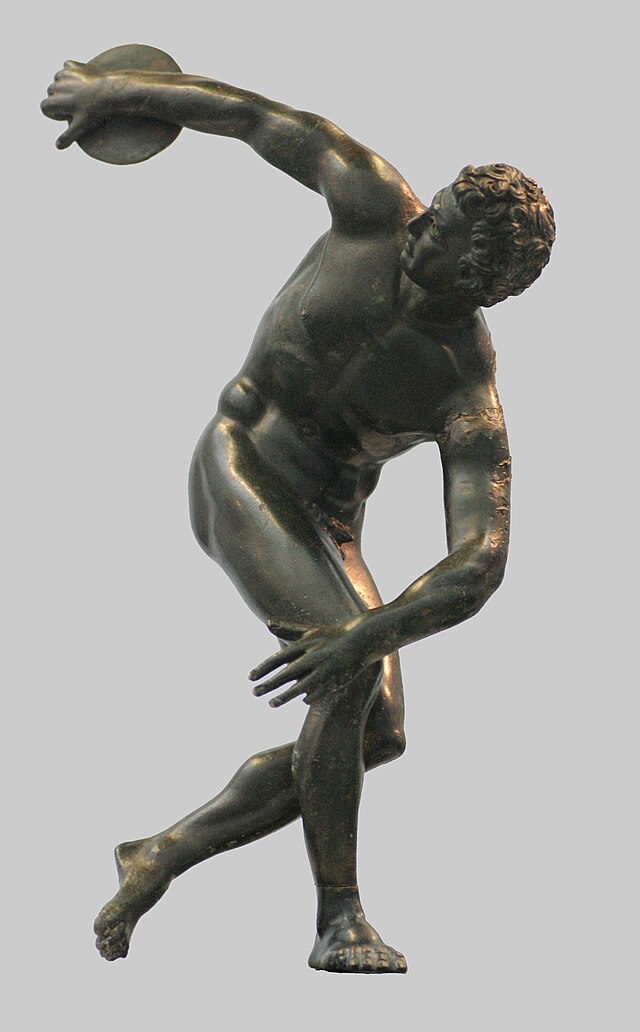
Myron’s Discobolus is a famous Classical Greek sculpture that captures an athlete at the peak moment before a discus throw.
Overview
The Discus Thrower (Discobolus) is one of the most celebrated sculptures of ancient Greece. Created around c. 450 BCE by the Greek sculptor Myron, it depicts an athlete winding up to throw a discus. Although the original bronze statue is lost, the work is known today through several Roman marble copies made centuries later.
The sculpture became famous for its vivid sense of motion, balance, and idealized athletic form. It is a key example of Classical Greek art, showing how artists of the period sought to combine realism, harmony, and mathematical order. Rather than portraying a specific athlete, the statue presents an ideal human body at the height of physical control.
Creation
Myron was active during the early Classical period, a time when Greek sculptors were moving away from the rigid poses of Archaic art. The Discobolus reflects this artistic shift. Instead of standing stiffly, the athlete twists his torso, bends his knees, and draws one arm back, creating a complex spiral pose.
The original work was cast in bronze, a medium favored by Greek sculptors because it allowed for dynamic compositions and fine anatomical detail. Bronze could support extended limbs more effectively than stone, making it ideal for ambitious athletic poses. The marble versions seen in museums today required additional supports, such as tree trunks or struts, because marble is more fragile.
Ancient writers praised Myron for his skill in depicting movement, and the Discobolus became one of his best-known works.
Style and Technique
The Discus Thrower is admired for its careful balance between motion and control. The athlete appears caught in a brief instant just before releasing the discus. This “frozen moment” was a major innovation in Greek sculpture, showing a new interest in movement rather than static display.
At the same time, the figure remains highly ordered. The limbs and torso form a rhythmic composition of arcs and opposing lines. The face is calm and expressionless, reflecting the Classical Greek ideal that physical action should be matched by inner composure. This blend of energy and restraint helped define the style of the period.
The anatomy is idealized rather than fully naturalistic. Muscles are clearly modeled, but not exaggerated. The result is not a portrait of strain, but a vision of perfect athletic beauty and discipline.
Legacy
The Discobolus had a lasting impact on the history of art. Roman collectors admired it enough to commission multiple copies, ensuring its survival after the original disappeared. In modern times, it has become one of the most recognizable images of ancient athleticism.
Art historians often use the sculpture to illustrate the values of Classical Greece: proportion, balance, and the celebration of the human body. It also remains closely linked to the history of sport, especially the Olympic tradition. Because of its fame, the Discus Thrower appears frequently in textbooks, museums, and discussions of ancient Greek sculpture.
Today, important Roman copies are held in major collections, including the Museo Nazionale Romano in Rome and the British Museum in London. These copies continue to shape public understanding of Myron’s lost masterpiece.
Did You Know?
- The original Discobolus was made of bronze, but all surviving versions are Roman marble copies.
- Myron likely did not depict a real athlete; the statue represents an idealized sportsman.
- The sculpture captures the moment just before the throw, not the release itself.
- The calm facial expression reflects Classical Greek ideals of self-control and harmony.
- The Discobolus is one of the best-known surviving images associated with ancient Greek athletics.