> THE CREATION OF ADAM
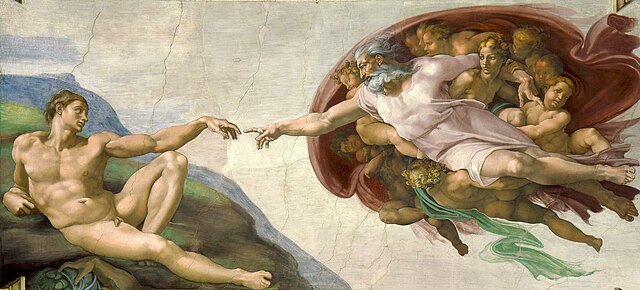
Michelangelo’s The Creation of Adam is a landmark High Renaissance fresco on the Sistine Chapel ceiling, famed for its powerful image of divine creation.
Overview
The Creation of Adam is one of the most famous artworks in Western history. Painted by Michelangelo between about 1508 and 1512, it forms part of the ceiling decoration of the Sistine Chapel in Vatican City. The fresco illustrates the biblical moment from the Book of Genesis in which God gives life to Adam, the first man.
The image is especially renowned for the nearly touching hands of God and Adam. That small gap between their fingers has become one of the most recognizable visual symbols in art. More broadly, the fresco represents key ideals of the High Renaissance: harmony, human anatomy, dramatic composition, and the blending of classical beauty with Christian theology.
Creation
Pope Julius II commissioned Michelangelo to repaint the Sistine Chapel ceiling, a massive project covering hundreds of figures and scenes. Although Michelangelo considered himself primarily a sculptor, he accepted the challenge and created one of the defining achievements of Renaissance art.
The Creation of Adam appears among the central narrative panels illustrating scenes from Genesis. In this composition, Adam reclines on the earth, newly formed but not yet fully animated. God, surrounded by a host of angels and borne on a swirling cloak, reaches toward him with commanding energy. Adam mirrors God’s gesture, suggesting that humanity is made in the image of the divine.
Art historians often note how Michelangelo transformed a brief biblical passage into a deeply human and monumental scene. Rather than showing a static act of creation, he depicted a charged instant of anticipation, when life is about to pass from creator to creation.
Style and Technique
This fresco is a masterclass in Renaissance design. Michelangelo used powerful anatomical modeling to give both God and Adam idealized, sculptural bodies. Adam’s figure reflects Michelangelo’s deep study of the human form, while God appears vigorous, intelligent, and authoritative.
The composition is strikingly simple yet dynamic. Adam occupies the left side in a relaxed pose, tied to the earth, while God rushes in from the right in a burst of movement. Their opposing energies create tension and focus the viewer’s attention on their hands.
As a fresco, the painting was executed on wet plaster, requiring speed, planning, and technical precision. Michelangelo worked on the ceiling at great height, designing scenes that would remain legible from below. The clear contours, monumental forms, and restrained background help make the image readable even at a distance.
Legacy
Over the centuries, The Creation of Adam has become an icon of Renaissance art and religious painting. It is frequently reproduced in books, films, advertisements, and popular culture. Its visual language is so powerful that even isolated details—especially the hands—are instantly recognizable.
The fresco also continues to inspire scholarly debate. Some researchers have proposed symbolic meanings in the red cloak surrounding God, including possible references to the human brain or womb, though such interpretations remain debated. What is certain is the work’s lasting influence on discussions of art, theology, and the representation of humanity.
Today, visitors to the Sistine Chapel still look upward to see the fresco in its original architectural setting. Its enduring appeal lies in its combination of spiritual meaning, artistic mastery, and emotional immediacy.
Did You Know?
- The Creation of Adam is not a standalone painting; it is one panel within Michelangelo’s larger Sistine Chapel ceiling program.
- Michelangelo painted the ceiling in fresco, applying pigment to fresh plaster so the color bonded with the wall surface.
- The famous gap between God’s and Adam’s fingers heightens the drama by suggesting the exact instant before life is given.
- Although celebrated as a painter today, Michelangelo originally identified more strongly as a sculptor.
- The Sistine Chapel is located in Vatican City and remains one of the most visited artistic and religious sites in the world.