> INVENTION OF THE PRINTING PRESS
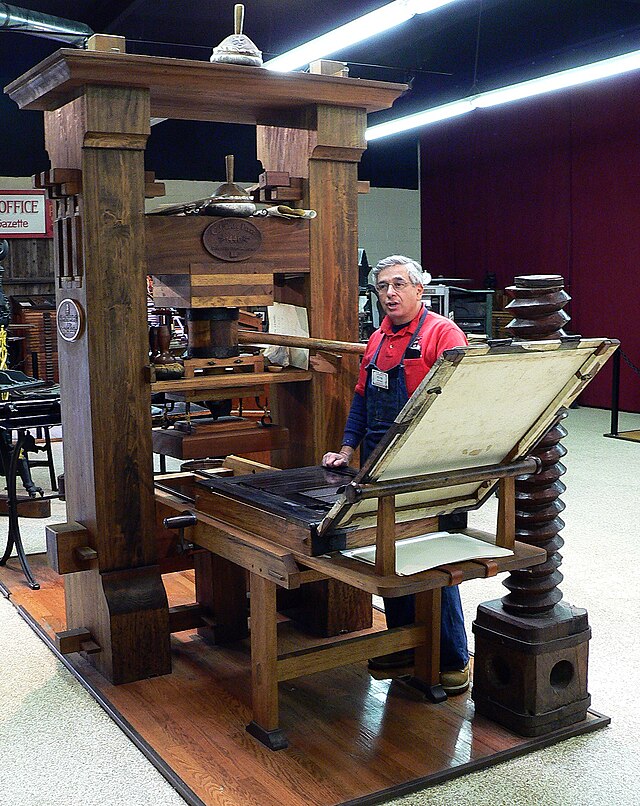
Johannes Gutenberg’s printing press transformed communication by making books faster, cheaper, and more widely available.
Overview
The invention of the printing press in Europe around c. 1440 was one of the most important technological events in world history. Developed in Mainz, in the Holy Roman Empire, by Johannes Gutenberg, the press introduced a practical system of movable metal type that allowed texts to be reproduced far more quickly than by hand. Before printing, books in Europe were copied manually by scribes, a slow and expensive process that limited access to knowledge.
Gutenberg’s innovation did not invent printing itself, since woodblock printing and movable type had appeared earlier in East Asia. However, his system combined several technologies in a new and effective way: durable metal type, oil-based ink, and a screw press adapted from existing agricultural tools. Together, these advances made large-scale book production possible in Europe.
Background
Before the printing press, most European books were produced in monasteries or workshops by hand. A single manuscript could take months or even years to complete. As a result, books were costly and usually owned only by churches, universities, and wealthy elites. Growing cities, expanding trade, and rising literacy in the late medieval period increased demand for texts, especially religious works, legal documents, and classical learning.
Paper, which had gradually spread into Europe from China through the Islamic world, also helped prepare the way for print. It was cheaper than parchment and better suited for mass production. By the fifteenth century, Europe had both the economic demand and the material conditions needed for a printing revolution.
The Invention and Early Printing
Johannes Gutenberg’s breakthrough likely came in the 1440s. His press used individual metal letters that could be arranged into words and pages, inked, and pressed onto paper. After printing, the type could be reused for new pages, making production much faster than hand-copying.
The most famous early product of this technology was the Gutenberg Bible, printed around 1454–1455. Often praised for its clarity and craftsmanship, it demonstrated that printed books could rival handwritten manuscripts in beauty while being produced in multiple identical copies. Although Gutenberg faced financial troubles and legal disputes, the method spread rapidly.
By the end of the fifteenth century, printing presses had appeared in major European cities such as Venice, Paris, and Nuremberg. Printers produced Bibles, scholarly texts, pamphlets, calendars, and vernacular literature. These early printed works are known as incunabula, meaning books printed before 1501.
Impact and Legacy
The printing press changed Europe’s intellectual, religious, and social life. It lowered the cost of books, increased access to information, and helped standardize texts. Scholars could compare editions more easily, share discoveries, and preserve knowledge with greater accuracy.
Its influence was especially important during the Renaissance, when printed classical works supported humanist learning, and during the Protestant Reformation, when pamphlets and translated Bibles allowed religious ideas to spread quickly. Printing also encouraged the growth of literacy, publishing, and eventually newspapers.
In the long term, the invention of the printing press reshaped communication in ways often compared to the modern digital revolution. It created a foundation for mass education, scientific exchange, and public debate. For these reasons, the printing press remains a landmark in the history of technology and media.
Did You Know?
- Johannes Gutenberg is credited with developing Europe’s movable-type printing press around c. 1440 in Mainz.
- The Gutenberg Bible was one of the first major books printed in Europe using movable metal type.
- Earlier forms of printing had already existed in East Asia centuries before Gutenberg’s press.
- Books printed before 1501 are called incunabula, a term from Latin meaning “swaddling clothes” or “early infancy.”
- Within about 50 years of Gutenberg’s invention, millions of printed books had been produced across Europe.