> THE THINKER
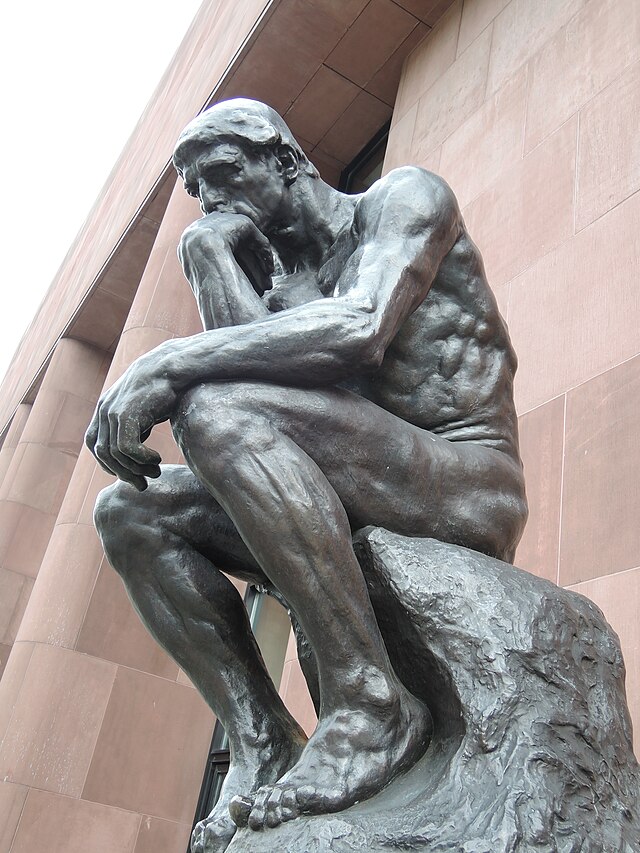
Auguste Rodin’s The Thinker became one of the most famous sculptures in modern art, symbolizing reflection, intellect, and human struggle.
Overview
The Thinker is a bronze sculpture by the French artist Auguste Rodin and one of the best-known artworks in the history of sculpture. Although often treated as a standalone masterpiece, it was originally conceived as part of Rodin’s vast project The Gates of Hell. The seated male figure, leaning forward with chin resting on one hand, has come to represent deep thought, philosophy, and the weight of human experience.
The sculpture is closely associated with 1904, the year one of the first enlarged bronze casts was exhibited publicly. From that point, The Thinker gained wide recognition and became an international symbol of intellect and contemplation. Its fame has only grown through reproductions, museum displays, and frequent references in popular culture.
Creation
Rodin began designing the figure around 1880 while working on The Gates of Hell, a monumental portal inspired in part by Dante Alighieri’s Divine Comedy. In that larger composition, the figure was likely intended to represent Dante himself, seated above the doors and contemplating the scenes of suffering below. Over time, however, the sculpture took on a broader meaning and was appreciated independently from the larger work.
Unlike idealized classical figures, Rodin’s sculpture emphasizes tension and physical presence. The muscular body is active rather than at rest, suggesting that thought is a form of labor. This approach helped distinguish Rodin from earlier academic traditions and linked his work to the emergence of modern sculpture.
Style and Technique
The Thinker reflects Rodin’s interest in realism, expressive anatomy, and unfinished-looking surfaces that capture light dramatically. The figure’s pose is compact and powerful: the back curves forward, the toes grip the base, and the whole body appears engaged in concentration. Rather than presenting thought as calm detachment, Rodin portrays it as intense, physical, and even burdensome.
Rodin first modeled the work in plaster before it was cast in bronze, a process that allowed for multiple authorized versions in different sizes. The bronze medium gave the sculpture durability and broad visibility, helping it reach museums, gardens, and public spaces across the world. Its rough-textured surface, another hallmark of Rodin’s style, creates a vivid sense of life and movement.
Legacy
The legacy of The Thinker is unusually broad for a sculpture. It has become a visual shorthand for thinking itself, appearing in textbooks, films, advertising, and political cartoons. This recognition has made it one of the most reproduced sculptures in modern history.
Art historians view The Thinker as central to Rodin’s reputation and to the transition from traditional monument sculpture to more expressive modern forms. Its influence can be seen in later sculpture that values emotion, gesture, and psychological depth over polished perfection. Today, major casts of The Thinker are held in institutions such as the Musée Rodin in Paris, where it remains a key attraction and a landmark of European art.
Did You Know?
- The Thinker was originally part of Rodin’s larger project The Gates of Hell, not first designed as a separate artwork.
- The figure may have begun as an image of Dante, reflecting on the damned souls below him.
- One of the best-known large bronze versions was publicly presented in 1904.
- Rodin’s sculpture is famous for showing thought as physical effort, not quiet stillness.
- There are multiple authorized casts of The Thinker in museums and public collections around the world.