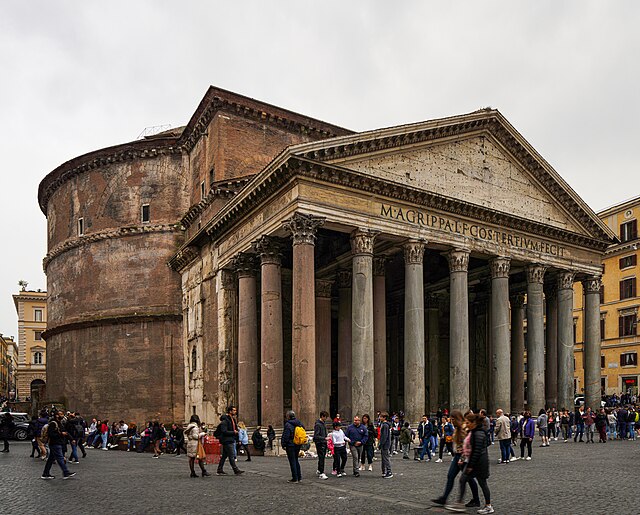
> PANTHEON
Ancient Roman temple in Rome famed for its vast dome, oculus, and extraordinary preservation across nearly two millennia.
Overview
The Pantheon is one of the most remarkable surviving buildings from ancient Rome. Located in the heart of Rome, it is famous for its massive dome, grand portico, and circular interior. Originally built as a temple and later converted into a church, the Pantheon has remained in continuous use for centuries, helping preserve it in extraordinary condition.
Historical Background
The current Pantheon was built during the reign of Emperor Hadrian in the early 2nd century AD, replacing an earlier structure associated with Marcus Agrippa. Although its exact original religious function is still debated, it was clearly one of the most ambitious architectural projects of imperial Rome. In later centuries, its conversion into a Christian church helped save it from the destruction or stone-robbing that damaged many other ancient monuments.
Architecture
The Pantheon’s greatest architectural achievement is its enormous concrete dome, which remains the largest unreinforced concrete dome in the world. At its center is the oculus, a circular opening that admits light and rain, creating dramatic effects inside the building. The height of the interior from floor to oculus matches the width of the rotunda, producing a harmonious geometric space. The combination of engineering daring and visual balance makes the Pantheon one of the masterpieces of world architecture.
Legacy
The Pantheon has influenced countless buildings, from Renaissance churches to modern civic structures. Architects have long admired its proportions, materials, and structural genius. It also serves as a burial place for notable figures, including the artist Raphael. Today, it stands as a rare bridge between ancient Rome and the living city around it.
Did You Know?
- The Pantheon’s dome is still the largest unreinforced concrete dome in the world.
- The oculus is the building’s main source of natural light.
- It has been in near-continuous use for many centuries.
- The artist Raphael is buried inside the Pantheon.