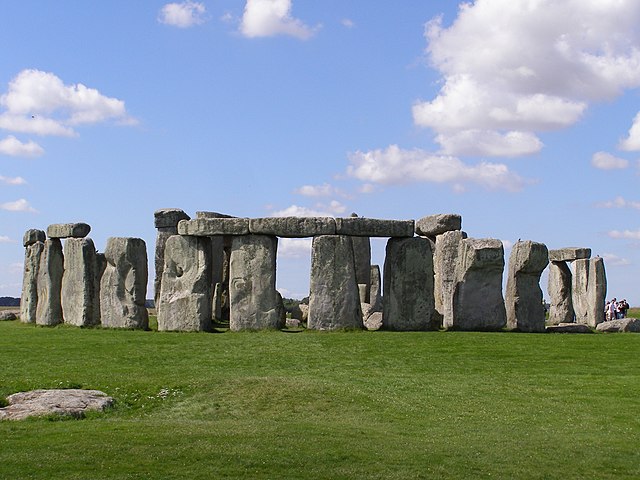
> STONEHENGE
Prehistoric stone circle in southern England, one of the most famous monuments in the world and a Neolithic engineering mystery.
Overview
Stonehenge is a ring of massive standing stones on Salisbury Plain in Wiltshire, England. Built in stages over more than a thousand years during the Neolithic and early Bronze Age, it is among the most studied archaeological sites on Earth. Scholars still debate its original function, but its scale, alignment, and craftsmanship make it one of the most remarkable achievements of prehistoric Europe.
Construction
The monument was raised in several major phases. Around 3000 BCE, Neolithic builders dug a circular earthwork enclosed by a ditch and bank. About five hundred years later, the site was transformed with two kinds of stone: enormous sarsens hauled roughly twenty miles from the Marlborough Downs, and smaller bluestones transported nearly 150 miles from the Preseli Hills in Wales. The largest sarsens weigh around twenty-five tons. They were shaped with stone hammers and joined using mortise-and-tenon joints borrowed from woodworking, a technique unknown elsewhere in prehistoric stone architecture.
Purpose and Alignment
Stonehenge is carefully aligned with the movement of the sun. On the summer solstice, the rising sun appears directly over the Heel Stone when viewed from the center of the ring; on the winter solstice, the sun sets between the tallest stones. This has led most archaeologists to interpret Stonehenge as a ceremonial or religious monument tied to the solar calendar and the agricultural year. Excavations of surrounding cremation burials suggest it also served as one of Britain's earliest large cemeteries, linking the site to ancestor veneration and the cycles of life and death.
Legacy
Stonehenge has been studied, mythologized, and protected for centuries. In earlier eras it was attributed to the Romans, the Druids, or even giants; today it is recognized as the work of Neolithic farming communities using sophisticated surveying and engineering methods. It was designated a UNESCO World Heritage Site in 1986 along with nearby Avebury. Each year more than a million visitors travel to see the stones, and tens of thousands gather at sunrise on the summer solstice, continuing a tradition that may stretch back more than four thousand years.
Did You Know?
- The Welsh bluestones were moved roughly 150 miles to the site.
- Stonehenge predates the Great Pyramid of Giza.
- The monument aligns with both the summer and winter solstices.
- Some of the original stones have fallen or been lost over the centuries.