> GREAT WALL OF CHINA
Vast system of fortifications built across northern China over more than two millennia, stretching thousands of kilometers.
Overview
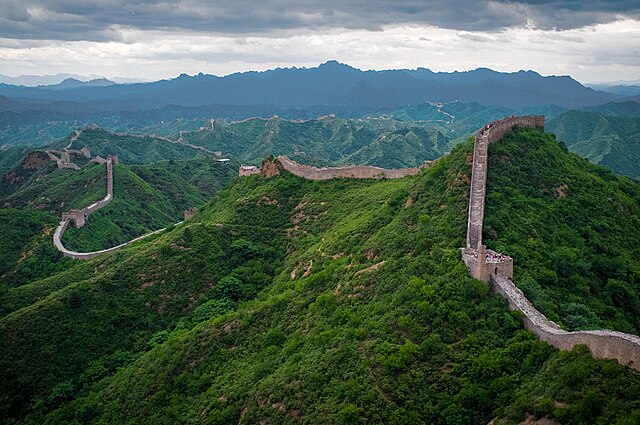
The Great Wall of China is not a single wall but an enormous network of walls, watchtowers, beacon towers, barracks, and fortresses stretching across northern China. Built in stages by different dynasties between the seventh century BCE and the seventeenth century CE, the system was designed to protect agricultural Chinese states from nomadic peoples of the northern steppe. A 2012 survey by China's State Administration of Cultural Heritage put the total length — including all branches, natural barriers, and ruined sections — at more than 21,000 kilometers.
Early Construction
The first large walls were raised during the Warring States period (roughly 475–221 BCE), when rival Chinese kingdoms fortified their northern borders with rammed-earth ramparts. When Qin Shi Huang unified China in 221 BCE, he ordered these walls linked and extended into a single defensive line. Hundreds of thousands of laborers — soldiers, peasants, and prisoners — worked on the project, and many are believed to have died during construction. Later dynasties, particularly the Han (206 BCE–220 CE), pushed the walls further west to protect trade along the emerging Silk Road.
The Ming Wall
The structure most visitors recognize today was built under the Ming dynasty (1368–1644). After the Ming expelled the Mongol Yuan dynasty, they constructed a new, far more ambitious fortification of stone and brick to guard against Mongol raids. The Ming wall stretches roughly 8,850 kilometers from Hushan in the east to the Jiayu Pass in the west. It is punctuated by more than seven thousand watchtowers, with signal fires and smoke columns used to relay warnings of an attack across hundreds of kilometers in hours. Despite its scale, the wall did not always succeed militarily: in 1644, the Manchus crossed it and founded the Qing dynasty, ending large-scale wall construction.
Legacy
The Great Wall has become the most famous symbol of Chinese civilization. It was inscribed on the UNESCO World Heritage List in 1987 and visited by millions of tourists each year, especially at the restored sections near Beijing such as Badaling and Mutianyu. Large parts of the wall, however, remain unrestored and are slowly eroding from weather, farming, and — in some areas — the removal of stones for construction material. A widely repeated myth holds that the wall is visible from the Moon with the naked eye; astronauts have confirmed this is false, although it can be glimpsed from low Earth orbit under ideal conditions.
Did You Know?
- The total length of all branches exceeds 21,000 kilometers.
- Many sections were built from rammed earth, not stone.
- Signal fires allowed warnings to travel faster than horseback.
- The wall is not a single continuous line but many parallel and overlapping walls.