> STATUE OF LIBERTY
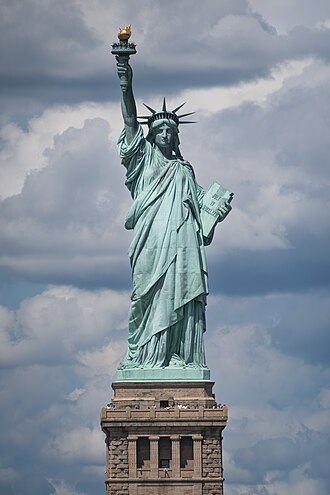
Colossal neoclassical copper statue on Liberty Island in New York Harbor, a gift from France and a global symbol of freedom.
Overview
The Statue of Liberty is a 93-meter copper-and-steel colossus standing on Liberty Island in New York Harbor. Given to the United States by the people of France and dedicated in 1886, it depicts the Roman goddess Libertas holding a torch aloft and cradling a tablet inscribed with the date of American independence. More than a monument, it became the first sight for millions of immigrants arriving by ship through Ellis Island and has since grown into one of the most recognized symbols of liberty, democracy, and the immigrant experience in the world.
Design and Construction
The idea for the statue was proposed by the French jurist Édouard de Laboulaye in the 1860s as a gift commemorating the centenary of American independence and the abolition of slavery. The sculptor Frédéric Auguste Bartholdi designed the figure, inspired in part by his mother's features and by the colossal ancient statues of the Mediterranean. The internal iron framework — essential for supporting the thin, hammered copper skin — was engineered by Gustave Eiffel, later famous for the Eiffel Tower. The statue was built in Paris, disassembled into 350 pieces, packed into 214 crates, and shipped across the Atlantic in 1885. The pedestal, paid for by American donors — including pennies from schoolchildren after a fundraising campaign led by the publisher Joseph Pulitzer — was designed by the architect Richard Morris Hunt.
Symbolism
The statue's iconography is dense with meaning. The seven rays of her crown represent the seven continents and seven seas. The tablet in her left hand is inscribed "July IV, MDCCLXXVI" — July 4, 1776, the date of American independence. Broken shackles lie at her feet, a reference to the end of slavery that is often missed by visitors. In 1903, the poet Emma Lazarus's sonnet "The New Colossus" was mounted on a bronze plaque inside the pedestal, transforming the meaning of the monument for a new era of immigration: "Give me your tired, your poor, / Your huddled masses yearning to breathe free." That line, not part of the original conception, became the statue's most famous inscription.
Legacy
The statue is made of copper only 2.4 millimeters thick — about the thickness of two pennies stacked together. That copper oxidized over several decades to form the characteristic green patina. Lightning has struck the statue many times; it is designed to absorb the strikes safely through its iron framework. A major restoration in 1986 replaced the corroded torch, and a new base was built after the September 11 attacks closed the interior to the public. Designated a National Monument in 1924 and a UNESCO World Heritage Site in 1984, the statue receives over four million visitors annually.
Did You Know?
- The statue's copper skin is only about 2.4 millimeters thick.
- She originally had a brown coppery finish before oxidizing green.
- Gustave Eiffel — of Eiffel Tower fame — engineered her internal skeleton.
- The broken shackles at her feet represent the end of slavery.