> EIFFEL TOWER
Wrought-iron lattice tower in Paris built for the 1889 World's Fair and now one of the most recognized landmarks in the world.
Overview
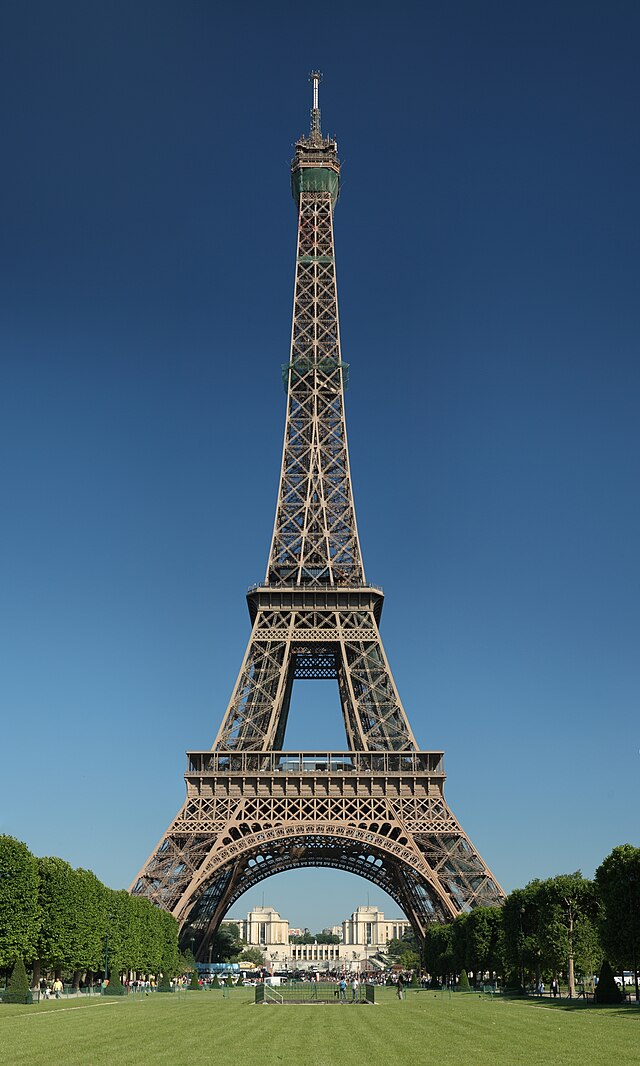
The Eiffel Tower is a 330-meter wrought-iron lattice tower on the Champ de Mars in Paris, France. Built as the entrance arch for the 1889 Exposition Universelle — the world's fair celebrating the centennial of the French Revolution — it was the tallest man-made structure on Earth for forty-one years. What began as a temporary exhibit has become the defining symbol of Paris and one of the most visited paid monuments in the world.
Construction
The tower was designed by engineers Maurice Koechlin and Émile Nouguier of the firm owned by Gustave Eiffel, whose company had already built celebrated iron bridges and the internal armature of the Statue of Liberty. Construction began in January 1887 and took just over two years. Around three hundred workers assembled 18,038 pieces of puddled iron held together by roughly 2.5 million rivets. The design relied on careful mathematical calculations of wind resistance, which gives the tower its distinctive outward-curving base. Remarkably, only one worker died during construction — extraordinary for a project of its scale in the nineteenth century.
Reception and Controversy
Many Parisian artists and intellectuals loathed the tower before it was built. A famous 1887 petition signed by writers including Guy de Maupassant and Charles Gounod denounced it as a "useless and monstrous" iron column defacing the city. Once completed, however, the tower became an immediate sensation. Nearly two million people visited during the 1889 fair alone. Eiffel had secured a twenty-year concession, after which the city planned to dismantle it; but the tower proved invaluable as a radiotelegraph station and was granted a reprieve. Radio transmissions from its antenna helped the French military intercept German communications during the First World War.
Legacy
The Eiffel Tower remained the world's tallest structure until the Chrysler Building was completed in 1930. Today it is repainted roughly every seven years, uses more than sixty tons of paint each cycle, and receives around six million visitors annually. It has inspired copies and tributes worldwide, from Las Vegas to Tianjin, and it remains a working broadcast tower for radio and television. For many visitors, the night-time light show on the hour — twenty thousand bulbs sparkling for five minutes — is as iconic as the silhouette itself.
Did You Know?
- The tower grows several centimeters taller in summer heat due to metal expansion.
- It held the title of tallest structure in the world for forty-one years.
- Gustave Eiffel kept a private apartment near the top for entertaining guests like Thomas Edison.
- Painting the tower by hand takes around twenty-five painters about eighteen months.