> PARTHENON
Ancient Greek temple on the Acropolis of Athens, celebrated as a masterpiece of classical architecture and civic symbolism.
Overview
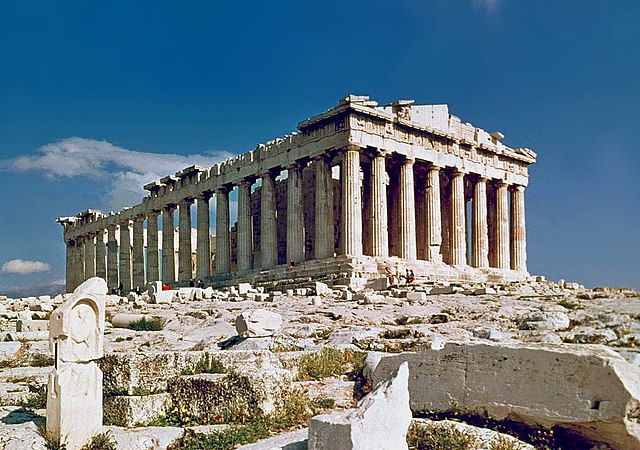
The Parthenon is one of the most famous monuments of the ancient world and a defining symbol of classical Greece. Standing atop the Acropolis in Athens, it was built as a temple dedicated to Athena, the city’s patron goddess. Its architectural refinement, political meaning, and artistic influence have made it one of the most studied buildings in history.
Historical Background
The Parthenon was built during the 5th century BC, in the age of Athenian power following the Persian Wars. It formed part of a major building program promoted by Pericles, who sought to glorify Athens and its democratic leadership. The temple was constructed on the site of earlier religious structures and was intended to express both devotion to Athena and the city’s cultural supremacy.
Architecture and Art
Designed primarily in the Doric order, the Parthenon also incorporates Ionic elements, creating a sophisticated blend of styles. Its architects, Ictinus and Callicrates, used subtle visual adjustments known as optical refinements, including slight curves and inclinations, to make the structure appear more perfectly balanced to the human eye. The temple once housed a monumental statue of Athena made by Phidias, and its sculptural decoration included metopes, friezes, and pediments depicting mythological scenes and civic identity.
Legacy
Over the centuries, the Parthenon has served as a temple, church, mosque, and ruin, yet it has never lost its symbolic power. It remains a benchmark of classical architecture and continues to shape ideas about beauty, proportion, and cultural heritage. For many people, it stands not only for ancient Greece but also for the enduring legacy of art, democracy, and public life.
Did You Know?
- The Parthenon was dedicated to Athena, protector of Athens.
- Its designers used optical refinements to improve visual harmony.
- A giant statue of Athena once stood inside the temple.
- It remains one of the most influential buildings in architectural history.