> MACHU PICCHU
Fifteenth-century Incan royal estate high in the Andes of Peru, renowned for its stonework, setting, and engineering.
Overview
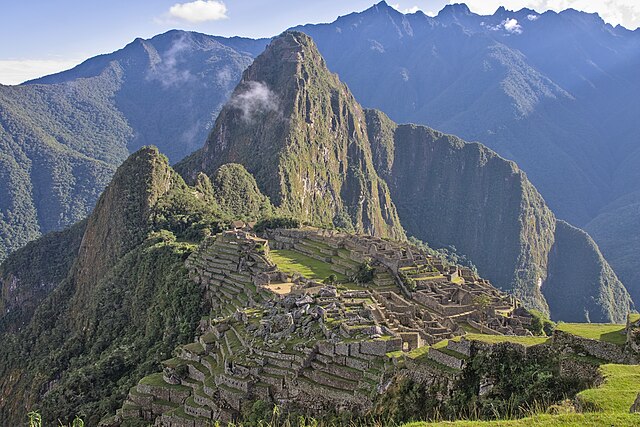
Machu Picchu is an Incan citadel perched on a mountain ridge 2,430 meters above sea level in southern Peru. Built in the mid-fifteenth century during the reign of the emperor Pachacuti, it is one of the finest surviving examples of Incan architecture and urban planning. Abandoned after the Spanish conquest and hidden by cloud and forest for centuries, it is now one of the most recognized archaeological sites in the world and was designated a UNESCO World Heritage Site in 1983.
Construction and Design
Machu Picchu was built between about 1450 and 1460. Incan architects chose an extraordinary location — a narrow saddle between two peaks, Huayna Picchu and Machu Picchu Mountain, with commanding views of the Urubamba River valley below. More than two hundred structures were laid out in an agricultural sector of terraces and a residential and ceremonial sector of plazas, temples, and dwellings. The finest buildings use ashlar masonry: granite blocks cut so precisely that they fit together without mortar, their joints too tight to slip a knife blade between them. Channels, fountains, and drainage systems carry mountain springs through the city, and the terraces prevent erosion on slopes that can exceed forty degrees.
Purpose and Abandonment
Most scholars believe Machu Picchu served as a royal estate for Pachacuti and his household, combining a country retreat, a religious center, and an administrative outpost. Features such as the Intihuatana stone — a carved granite pillar aligned with the sun — point to an important ceremonial role. The site was occupied for roughly a century and then abandoned around the time of the Spanish conquest of the Inca in the 1530s. Because the conquistadors never found it, Machu Picchu escaped the destruction inflicted on many other Incan cities and survived largely intact, albeit overgrown.
Rediscovery and Legacy
Local farmers and a few European travelers had seen the ruins before the twentieth century, but Machu Picchu was brought to international attention in 1911 by the American historian Hiram Bingham, who was led there by Peruvian guides while searching for a different lost city. His photographs and articles for National Geographic made the site a global sensation. Today, Machu Picchu is one of the New Seven Wonders of the World. Peruvian authorities carefully regulate visitor numbers to protect the stonework and the delicate ecosystem of the surrounding cloud forest.
Did You Know?
- The site's name means "Old Mountain" in the Quechua language.
- The stones were fitted so precisely they have survived major earthquakes.
- Machu Picchu was never found by Spanish conquistadors.
- More than sixty percent of the site is reportedly still underground or unexcavated.