> D-DAY (NORMANDY LANDINGS)
The Normandy landings opened the Western Front in Europe and marked a decisive turning point in World War II.
Overview
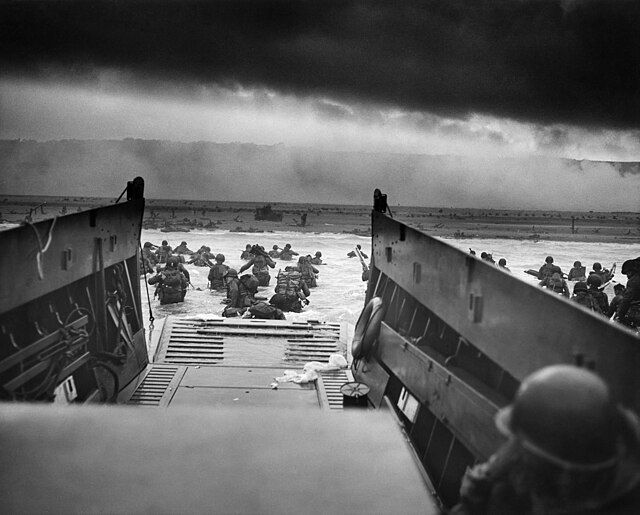
D-Day, the Normandy landings of June 6, 1944, was the largest amphibious invasion in military history and a critical operation of World War II. Codenamed Operation Overlord, it marked the beginning of the Allied campaign to liberate Nazi-occupied Western Europe. On that day, forces from the United States, United Kingdom, Canada, and other Allied nations crossed the English Channel and landed on five beaches along the Normandy coast of France: Utah, Omaha, Gold, Juno, and Sword.
The landings were led by General Dwight D. Eisenhower, Supreme Commander of the Allied Expeditionary Force. Success on D-Day did not end the war immediately, but it established a vital foothold in France and opened a major Western Front against Germany.
Background
By 1944, Nazi Germany controlled much of Europe. The Soviet Union had been pushing German forces back in the east, and the Western Allies faced intense pressure to launch a major invasion in the west. Planning for the Normandy invasion took months and involved enormous coordination of troops, ships, aircraft, supplies, and deception operations.
One of the most important deception plans was Operation Fortitude, which misled German commanders into expecting an invasion at Pas-de-Calais rather than Normandy. This helped reduce German readiness at the actual landing sites. Weather also played a major role. Rough seas and cloud cover forced commanders to delay the invasion by one day, but a brief break in conditions allowed the assault to proceed on June 6.
The Landings
In the early hours of D-Day, Allied paratroopers and glider troops were dropped behind enemy lines to seize bridges, block roads, and disrupt German defenses. Soon after, naval bombardment and air attacks struck coastal positions to support the seaborne assault.
The beach landings varied in difficulty. Utah Beach saw relatively lighter resistance, while Omaha Beach became the bloodiest sector for American forces due to strong German fortifications, steep terrain, and heavy fire. British troops landed at Gold and Sword, while Canadian forces assaulted Juno Beach. Despite heavy casualties and confusion on several beaches, Allied troops gradually broke through the Atlantic Wall defenses.
By the end of the day, more than 150,000 Allied troops had landed in Normandy. Although not all objectives were met on schedule, the invasion had succeeded in establishing a beachhead.
Impact and Legacy
D-Day was a turning point in the European theater of World War II. The successful landings allowed the Allies to bring men, vehicles, and supplies into France on a massive scale. In the weeks that followed, fierce fighting continued in Normandy, leading to the breakout from the beachhead and the liberation of Paris in August 1944.
The operation also demonstrated the importance of joint military planning across land, sea, and air forces. Today, D-Day is remembered not only as a major military success but also as a symbol of sacrifice, cooperation, and the struggle against tyranny. Cemeteries, memorials, and museums across Normandy continue to honor those who fought and died during the invasion.
Did You Know?
- The “D” in D-Day simply stands for “day,” a military term used for the start date of an operation.
- More than 11,000 Allied aircraft supported the invasion with transport, bombing, and fighter missions.
- Omaha Beach suffered the highest casualties of the five landing beaches on June 6, 1944.
- Artificial harbors called Mulberries were later used to unload supplies in Normandy after the landings.