> RMS TITANIC
British ocean liner that sank on its maiden voyage in 1912 after striking an iceberg, killing more than 1,500 people.
Overview
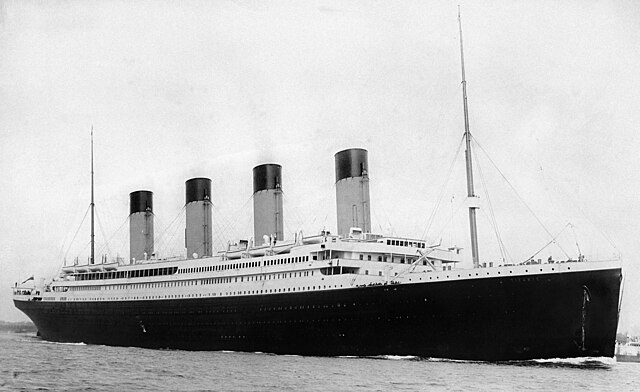
The RMS Titanic was a British passenger liner operated by the White Star Line that sank in the early hours of April 15, 1912, after striking an iceberg on her maiden voyage from Southampton to New York. Of the approximately 2,224 passengers and crew on board, more than 1,500 died — one of the deadliest peacetime maritime disasters in history. The Titanic had been advertised as "practically unsinkable," and the shock of her loss reshaped international maritime regulations and embedded the ship in popular culture for more than a century.
Design and Maiden Voyage
The Titanic was one of three Olympic-class liners built by Harland & Wolff in Belfast. At 269 meters long and more than 46,000 gross tons, she was the largest ship afloat at the time of her launch. She offered unprecedented luxury to first-class passengers — a Turkish bath, a heated indoor swimming pool, a grand staircase, à la carte restaurants — while carrying hundreds of third-class passengers, many of them immigrants bound for the United States. Her safety features included sixteen watertight compartments designed to keep her afloat if up to four were flooded. She could not, in principle, sink from any collision the designers had anticipated. That confidence, combined with regulations based on older and smaller ships, meant the Titanic carried only twenty lifeboats — enough for about half the people on board.
The Sinking
The Titanic left Southampton on April 10, 1912, picked up passengers in Cherbourg, France, and Queenstown, Ireland, and struck an iceberg at 23:40 ship's time on April 14 in the North Atlantic. The collision buckled the ship's hull plates along the starboard side and opened six of the sixteen compartments to the sea — two more than she could survive. The ship took about two hours and forty minutes to founder. Lifeboats were launched only partially filled, many at less than half capacity, and the water temperature of around –2 °C killed most of those who ended up in the sea within minutes. The RMS Carpathia arrived at dawn and rescued roughly 705 survivors; the rest were lost.
Aftermath and Rediscovery
The disaster prompted sweeping reforms. The first International Convention for the Safety of Life at Sea, held in 1914, mandated lifeboats for everyone on board, twenty-four-hour radio watches, and the creation of the International Ice Patrol to monitor Atlantic icebergs. The wreck lay undiscovered for more than seventy years until the oceanographer Robert Ballard located it in 1985, roughly 3,800 meters below the surface about 600 kilometers south of Newfoundland. The wreck is rapidly decaying — iron-eating bacteria are consuming the hull — and is protected by international treaty as a memorial.
Did You Know?
- The Titanic carried lifeboats for only about half her passengers and crew.
- The voyage was her maiden voyage — her first crossing in commercial service.
- The wreck was found in 1985 by oceanographer Robert Ballard.
- Iron-eating bacteria are actively consuming her hull on the seafloor.