> GEOFFREY CHAUCER
Medieval English poet, author of The Canterbury Tales, and a foundational figure in English literature.
Overview
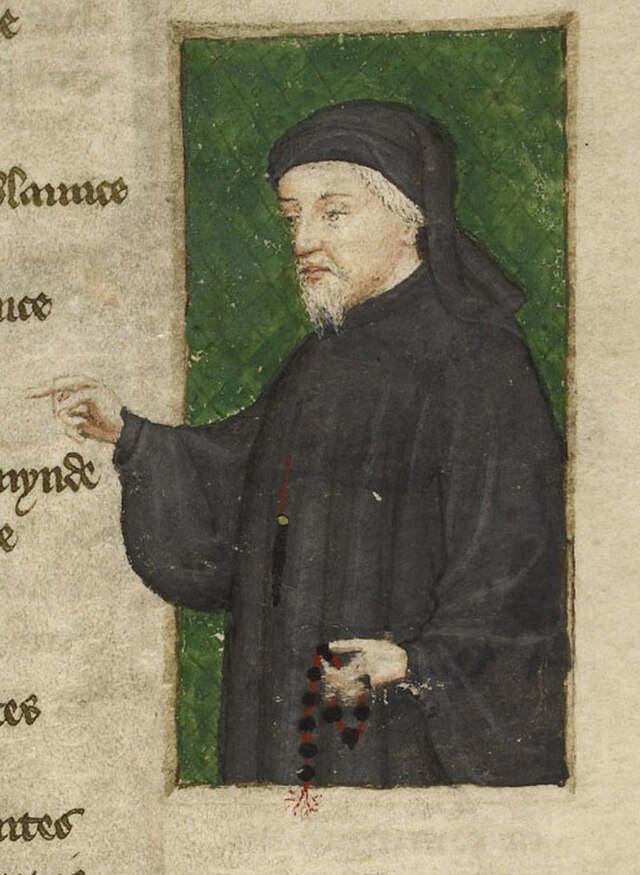
Geoffrey Chaucer was an English poet, author, philosopher, and civil servant widely regarded as the greatest English writer of the Middle Ages. His unfinished masterpiece The Canterbury Tales established a vivid cross-section of medieval English society and helped legitimize the use of vernacular English for serious literature at a time when Latin and French dominated elite culture. For this reason he is often called the "Father of English Literature."
Life and Career
Chaucer was born in London around 1343 to a family of wealthy wine merchants — the surname derives from the French chausseur or shoemaker. He entered royal service as a teenager, first as a page in an aristocratic household, then as a soldier in the Hundred Years' War, during which he was captured in France and ransomed by King Edward III. He rose through a long career of administrative posts: esquire to the king, diplomat on missions to Italy and France, comptroller of customs for the Port of London, and later clerk of the king's works overseeing royal buildings. These positions brought him into contact with Italian literature, especially the works of Dante, Petrarch, and Boccaccio, which deeply shaped his own poetry.
Major Works
Chaucer wrote in several genres before undertaking his most ambitious project. His early works include the dream-vision poems The Book of the Duchess and The Parliament of Fowls, along with Troilus and Criseyde, a long narrative poem set during the Trojan War that remains one of the finest love stories in English. Around 1387 he began The Canterbury Tales, a collection of stories told by a group of pilgrims traveling from Southwark to the shrine of Thomas Becket at Canterbury Cathedral. The framing device allowed Chaucer to write in wildly different voices — knight, miller, wife, pardoner, nun — and to range from chivalric romance to bawdy farce. He left the work unfinished at his death, having completed about twenty-four of a planned hundred-plus tales.
Language and Legacy
Chaucer wrote in Middle English at a moment when the language was still consolidating itself after centuries of Norman French rule over England's elites. By choosing vernacular English rather than Latin or French, he helped shape the literary direction the language would take. The Canterbury Tales also reveals a sharp eye for social observation and an unusually human sense of humor for a medieval writer. Chaucer died in 1400 and was buried in Westminster Abbey in what later became known as Poets' Corner, beginning a tradition of interring English literary giants there. His influence runs through Shakespeare, Spenser, and Dryden, and his work remains a cornerstone of English literature curricula worldwide.
Did You Know?
- Chaucer was the first person buried in what became Westminster Abbey's Poets' Corner.
- He was captured in France during the Hundred Years' War and personally ransomed by the king.
- The Canterbury Tales was left unfinished — only about a quarter of the planned stories were completed.
- He served as Clerk of the King's Works, overseeing repairs to royal palaces and building sites.