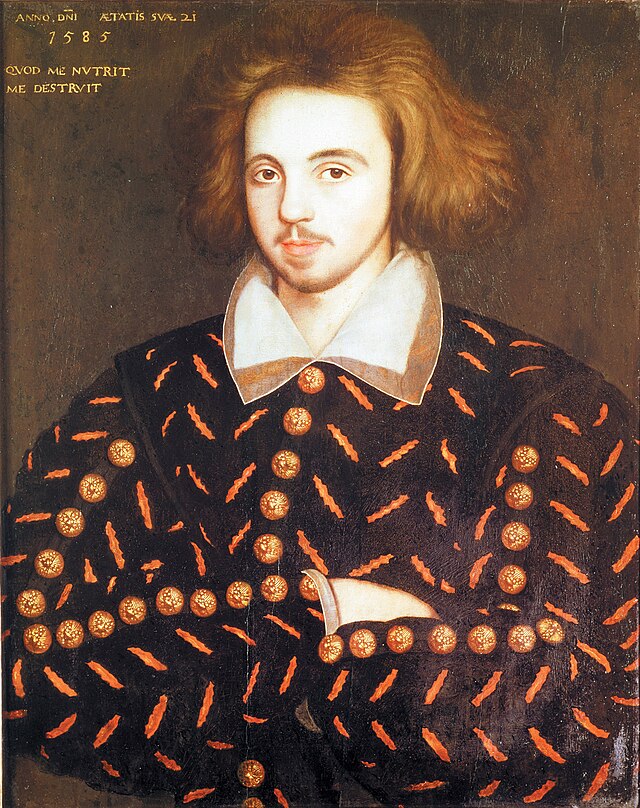
> CHRISTOPHER MARLOWE
Elizabethan playwright and poet whose blank-verse tragedies transformed English theater and who died in violent, still-mysterious circumstances at age twenty-nine.
Overview
Christopher Marlowe was an English playwright, poet, and translator of the Elizabethan era whose short, dramatic career transformed English theater. Born the same year as William Shakespeare, Marlowe rose to fame first and exerted a strong influence on Shakespeare's early work. In his handful of surviving plays he made blank verse — unrhymed iambic pentameter — the natural language of English tragedy, a choice that shaped the literary landscape for the next four centuries. He was killed at twenty-nine, leaving behind one of the most intriguing unsolved mysteries in English literary history.
Early Life
Marlowe was born in Canterbury in February 1564, the son of a shoemaker. He won a scholarship to the King's School in Canterbury and another to Corpus Christi College, Cambridge, where he studied for both his bachelor's and master's degrees. His university absences became the subject of an official complaint from college authorities, but the Privy Council intervened to insist he be awarded his degree, noting that he had been on "matters touching the benefit of his country." Most historians interpret this as confirmation that Marlowe had been employed, at least occasionally, as an agent in the intelligence service of Sir Francis Walsingham, Elizabeth I's spymaster.
Plays and Poetry
After Cambridge, Marlowe moved to London and almost immediately began producing plays that astonished audiences and other writers alike. Tamburlaine the Great, performed around 1587, introduced a heroic blank verse so dynamic that it came to be called "Marlowe's mighty line." The Jew of Malta, Edward II, and Dr. Faustus followed in quick succession — the last a landmark tragedy about a scholar who sells his soul to the devil for twenty-four years of knowledge and power. Marlowe also wrote the influential erotic poem Hero and Leander, left unfinished at his death and later completed by George Chapman, along with the lyric "The Passionate Shepherd to His Love."
Death and Legacy
In 1593 Marlowe was arrested on charges of atheism and sedition. He was free on bail when, on May 30 of that year, he was killed during a quarrel in a private house in Deptford. The official inquest recorded that he was stabbed over a disputed bill — the "reckoning" — in an argument with Ingram Frizer, who was quickly pardoned. Because the other two men present also had ties to intelligence networks, modern biographers have long speculated about political motives, ranging from the protection of a patron to silence over religious heterodoxy. His influence on Shakespeare, who was only beginning his own career at the time, was substantial: the ghost of Marlowe's muscular blank verse can be felt in plays from Titus Andronicus through Richard III. Marlowe died before he could match Shakespeare's output, but for English drama's short, brilliant takeoff he was, arguably, the pilot.
Did You Know?
- Marlowe was almost certainly working as a spy for Queen Elizabeth's intelligence service.
- He was born the same year as Shakespeare but rose to fame several years earlier.
- His Doctor Faustus is the first major English treatment of the Faust legend.
- He was killed in a tavern-like room in Deptford at age twenty-nine; the circumstances remain disputed.