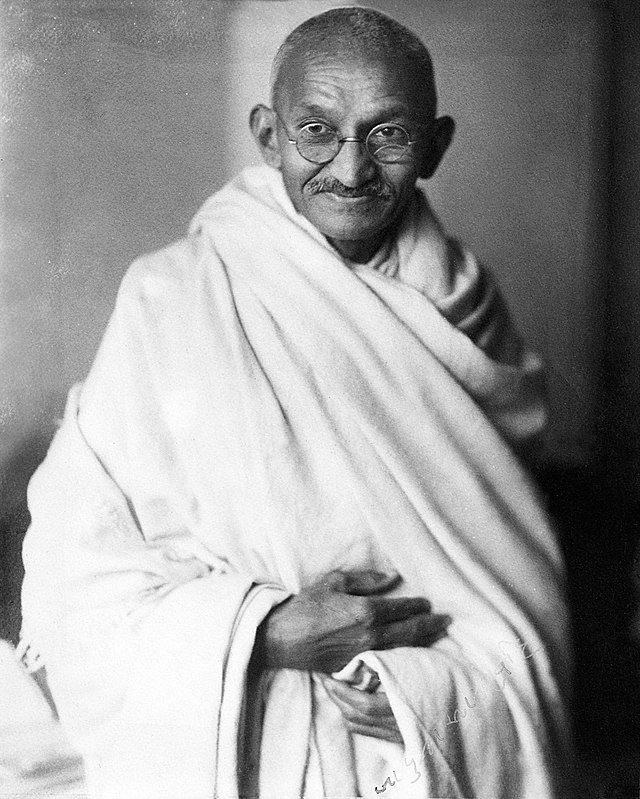
> MAHATMA GANDHI
Leader of India’s independence movement whose philosophy of nonviolent resistance influenced global civil rights struggles.
Overview
Mahatma Gandhi was the most internationally recognized leader of India’s struggle against British colonial rule. He developed and promoted a philosophy of nonviolent resistance that transformed political activism in the 20th century. His methods influenced movements for civil rights, freedom, and justice around the world.
Early Life
Gandhi was born Mohandas Karamchand Gandhi in 1869 in Porbandar, in present-day Gujarat, India. He studied law in London and later worked in South Africa, where he confronted racial discrimination firsthand. Those experiences were critical in shaping his moral and political beliefs. During this period, Gandhi began developing satyagraha, a philosophy based on truth, nonviolence, and civil resistance.
Leadership in India
After returning to India in 1915, Gandhi became a leading figure in the independence movement. He organized campaigns against unfair taxes, colonial laws, and British economic control. His methods included marches, boycotts, fasting, and civil disobedience. One of his most famous actions was the Salt March of 1930, which protested British control over salt production. Gandhi’s leadership brought millions of ordinary Indians into politics and gave the independence movement a powerful moral force.
Legacy
Gandhi’s ideas had a major impact beyond India. Leaders such as Martin Luther King Jr. and Nelson Mandela drew inspiration from his commitment to nonviolent resistance. At the same time, Gandhi’s legacy is also debated, and historians continue to examine his views and political choices critically. Even so, he remains one of the most influential figures of the modern age. He was assassinated in 1948, but his message of moral courage and disciplined protest continues to resonate worldwide.
Did You Know?
- Gandhi was trained as a lawyer before becoming a political leader.
- His 1930 Salt March became one of the most famous protests in history.
- The title “Mahatma” means “great soul.”
- His philosophy influenced major civil rights movements around the world.