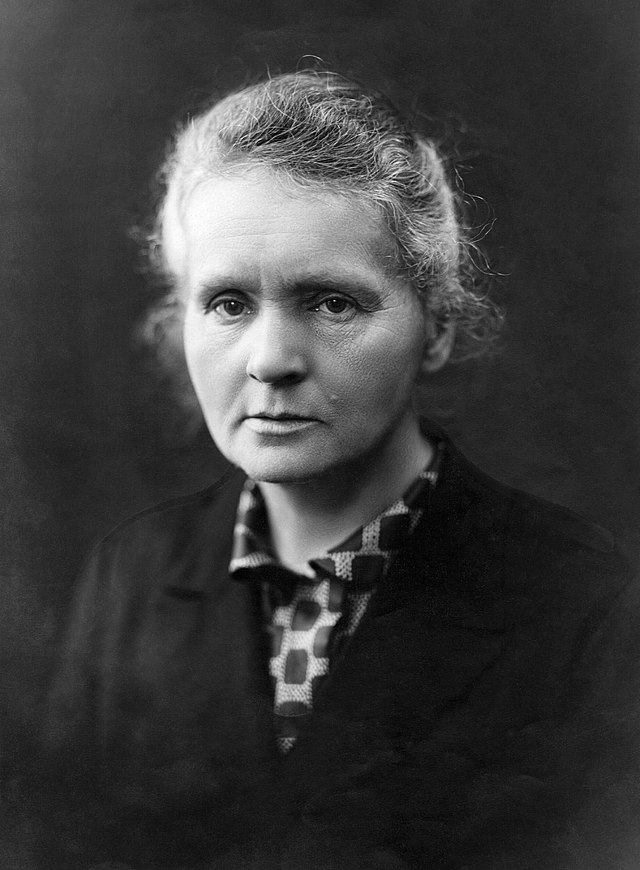
> MARIE CURIE
Scientist who pioneered research on radioactivity and became the first person to win two Nobel Prizes.
Overview
Marie Curie was a pioneering physicist and chemist whose research on radioactivity transformed science and medicine. She was the first woman to win a Nobel Prize and the only person to win Nobel Prizes in two different scientific fields. Her discoveries opened new possibilities in physics, chemistry, and medical treatment.
Early Life
Born in Warsaw, Poland, in 1867, Curie showed early academic talent despite limited opportunities for women. She moved to Paris to study at the Sorbonne, where she excelled in physics and mathematics. There, she met and married Pierre Curie, who became her research partner.
Scientific Discoveries
Curie’s work led to the discovery of two elements: polonium and radium. She developed methods for isolating radioactive isotopes and coined the term “radioactivity.” Her research laid the groundwork for advancements in nuclear science.
Impact on Medicine
During World War I, Curie developed mobile X-ray units to help treat wounded soldiers. Her work contributed to the development of radiation therapy, which is still used to treat cancer today.
Legacy
Marie Curie remains one of the most influential scientists in history. Her dedication and groundbreaking discoveries continue to inspire generations of researchers.
Did You Know?
- She won Nobel Prizes in Physics and Chemistry.
- Polonium was named after her homeland, Poland.
- She was the first female professor at the Sorbonne.
- Her notebooks are still radioactive today.