> NAPOLEON BONAPARTE
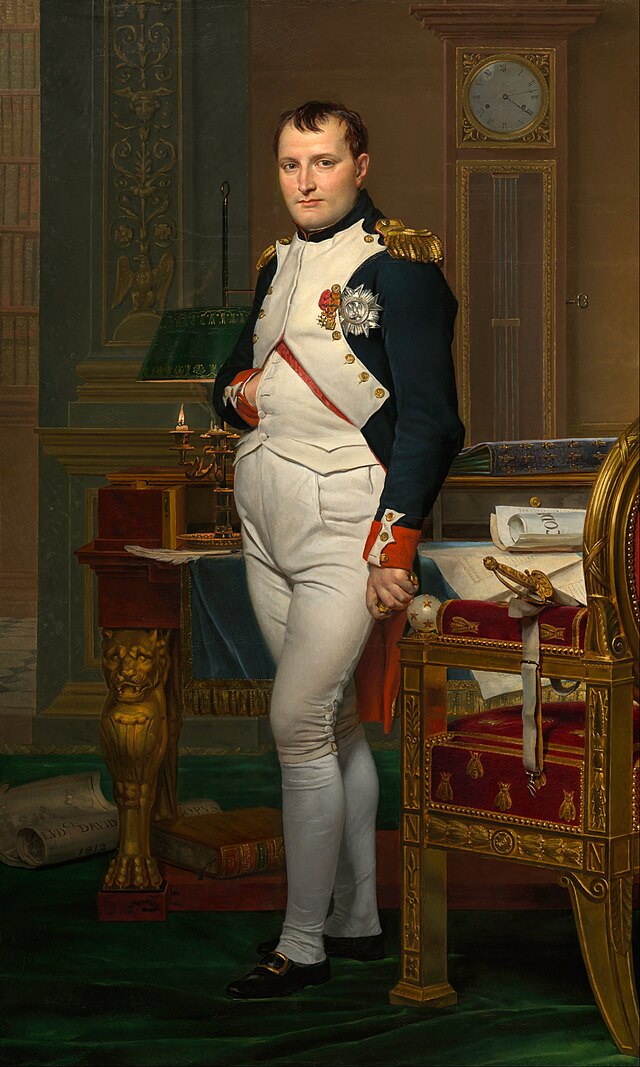
French general and emperor whose military campaigns and legal reforms reshaped Europe and whose name still defines an era.
Overview
Napoleon Bonaparte was a French military officer who rose from the provincial nobility of Corsica to become Emperor of the French and one of the most influential figures in European history. Between 1799 and 1815 he dominated continental Europe through a mix of battlefield genius, tireless administration, and ruthless political instinct. His career ended in defeat at Waterloo and exile, but his legal reforms, administrative structures, and military innovations shaped modern Europe for the next two centuries.
Early Life and Military Rise
Napoleone di Buonaparte was born in 1769 on the Mediterranean island of Corsica, just a year after France annexed it from the Republic of Genoa. Educated on the French mainland at military schools that trained him in artillery, he graduated as a second lieutenant at sixteen. The upheaval of the French Revolution gave him rapid promotion: he distinguished himself at the Siege of Toulon in 1793 at just twenty-four and later suppressed a royalist revolt in Paris with what he famously called a "whiff of grapeshot." By 1796 he commanded the French Army of Italy, where a series of brilliant victories against larger Austrian forces made him a national hero.
Emperor of the French
In 1799 Napoleon returned from an ambitious but ultimately stalled campaign in Egypt and seized power in a coup that installed him as First Consul. Five years later, a plebiscite made him Emperor of the French, and he famously crowned himself at Notre-Dame in Paris rather than let the Pope do it. His Napoleonic Code, promulgated in 1804, replaced a tangle of feudal laws with a single rational civil code based on equality before the law and protection of property; versions of it still underpin the legal systems of France, Belgium, Spain, Italy, parts of Germany, and many former colonies. Abroad, he defeated every major European power at least once, building a continental empire that stretched from Spain to Poland.
Downfall and Legacy
Napoleon's ambition eventually outran his resources. His disastrous 1812 invasion of Russia lost most of the Grande Armée to starvation, cold, and harassment. A coalition of Britain, Russia, Prussia, and Austria pushed him back to France and forced his abdication in 1814, exiling him to the Mediterranean island of Elba. He escaped, returned to power for one hundred days, and was finally defeated at the Battle of Waterloo in 1815. Exiled again — this time to the remote South Atlantic island of Saint Helena — he died there in 1821, most likely of stomach cancer. His career ended French dreams of universal empire but left Europe permanently changed: older regimes tried to restore themselves but could not unwind the administrative, legal, and national-identity revolutions he had set loose.
Did You Know?
- Napoleon spoke French with a distinct Corsican accent his whole life.
- His average height was around 5'6", normal for men of his time — the "short" legend comes from British propaganda.
- The Napoleonic Code is still the basis of civil law in much of continental Europe.
- His remains were returned to Paris in 1840 and lie in the Dôme des Invalides.