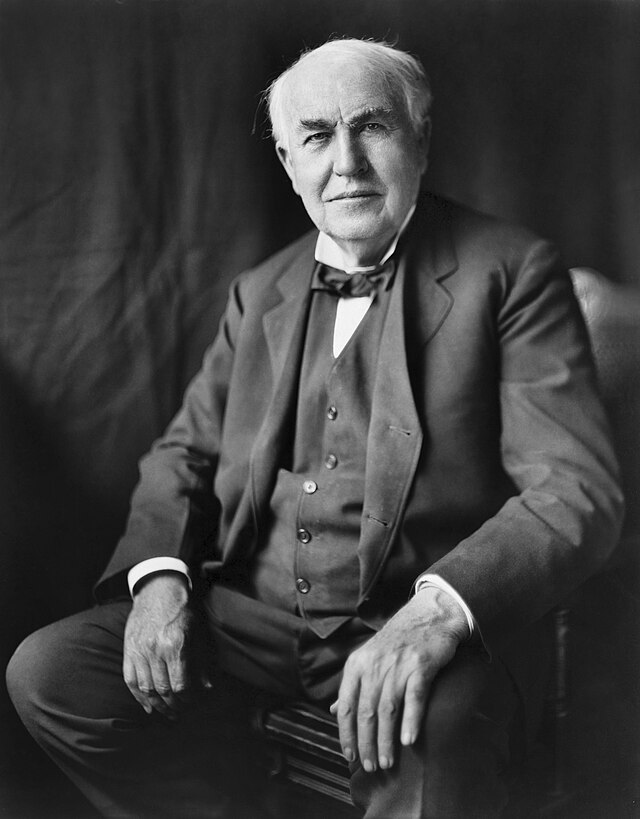
> THOMAS EDISON
American inventor and businessman whose laboratories produced the phonograph, the electric light system, and over a thousand patents.
Overview
Thomas Alva Edison was the most prolific inventor of his age and a defining figure in the rise of modern industrial technology. He developed or refined devices that shaped daily life in the late nineteenth and early twentieth centuries, including the phonograph, a practical incandescent light bulb, and the motion-picture camera. Just as important, he pioneered the modern research laboratory, turning invention itself into a disciplined, team-based industry.
Early Life
Edison was born in 1847 in Milan, Ohio, and raised in Port Huron, Michigan. Largely self-educated after only a few months of formal schooling, he credited his mother for teaching him to read widely. As a teenager he became a telegraph operator, traveling across the American Midwest and learning the electrical systems that would later underpin his inventions. By his early twenties he was filing his first patents, beginning with improvements to telegraphic equipment that earned him enough money to open a full-time workshop.
Major Inventions
In 1876 Edison opened his laboratory in Menlo Park, New Jersey, which he described as an "invention factory." There he introduced the phonograph in 1877, astonishing the public by reproducing the human voice from a tinfoil cylinder. Two years later, his team produced a long-lasting incandescent light bulb, a breakthrough that depended on a carbon filament and an improved vacuum. Edison then tackled the bigger problem of how to generate and distribute electricity, building the Pearl Street Station in New York in 1882 — the first commercial central power plant. His laboratories also developed the kinetoscope, an early motion-picture viewer that helped launch the film industry.
Legacy
Edison held 1,093 U.S. patents, more than any single American inventor for much of the twentieth century. His companies merged into what would eventually become General Electric, one of the largest corporations in the world. He was not always right — his advocacy of direct current lost out to Nikola Tesla and George Westinghouse's alternating current — but his insistence on systematic, well-funded research created the template for the modern R&D lab. He died in 1931, and on the night of his funeral, lights across the United States were briefly dimmed in tribute.
Did You Know?
- Edison filed his first patent at age twenty-two.
- His Menlo Park lab was sometimes called the "Wizard's Workshop."
- He personally tested thousands of materials before settling on a carbon filament.
- Edison was partially deaf from adolescence onward and considered it an asset for concentration.