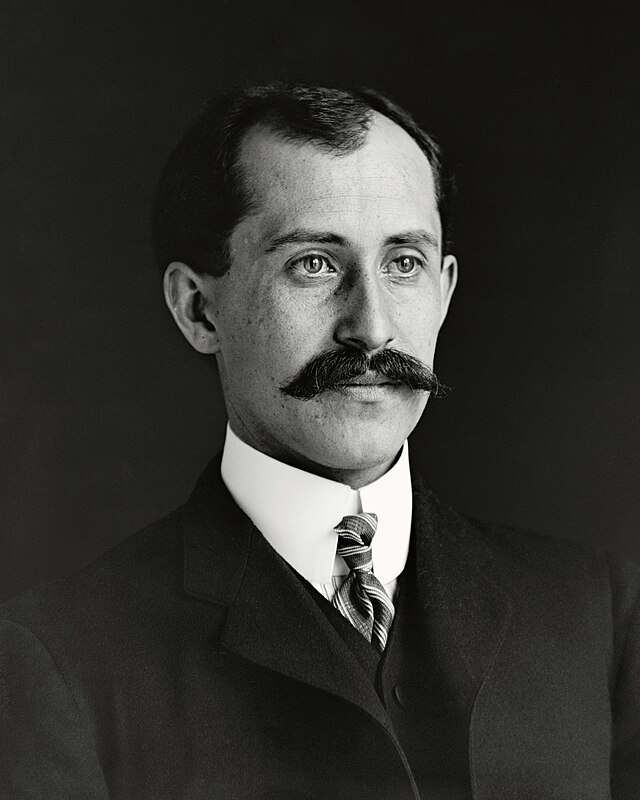
> WRIGHT BROTHERS
American inventors who designed, built, and piloted the first successful powered, controlled airplane in 1903.
Overview
Orville and Wilbur Wright were two American brothers from Dayton, Ohio, who made the first sustained, controlled, powered heavier-than-air flight on December 17, 1903. Self-taught engineers without a college degree between them, they solved problems that professional scientists, wealthy inventors, and European academies had spent decades failing to crack. Their breakthrough was not simply getting an aircraft off the ground but learning how to steer one — an insight that made practical aviation possible.
Early Work
The Wrights ran a printing shop and, from 1892, a bicycle repair and manufacturing business in Dayton. Their mechanical work on bicycles taught them about balance, control, and light-weight construction, all of which proved essential to their later aircraft. Inspired by the gliding experiments of the German engineer Otto Lilienthal, they began to study aerodynamics seriously in 1899. Over the next four years, they corresponded with the Smithsonian Institution, read everything available on aeronautics, and built their own wind tunnel to test wing shapes when they discovered existing data was unreliable.
The Flight at Kitty Hawk
The brothers chose Kill Devil Hills near Kitty Hawk, North Carolina, for their tests because of its steady winds and soft sand for landings. From 1900 to 1902 they flew increasingly sophisticated gliders, culminating in a controllable glider that used the key invention known as wing warping — twisting the wingtips to roll the aircraft — along with a movable rudder and elevator. By 1903 they built a twelve-horsepower aircraft they named the Flyer. On December 17, with Orville at the controls, the Flyer took off under its own power, flew 120 feet in twelve seconds, and landed safely. Three more flights followed that day, the longest lasting fifty-nine seconds and covering 852 feet.
Legacy
The Wrights spent the next several years refining their design in Ohio and eventually secured military contracts in the United States and France. Wilbur's 1908 demonstration flights in Europe stunned skeptical audiences and established the brothers as the undisputed pioneers of heavier-than-air flight. Wilbur died of typhoid fever in 1912 at age forty-five; Orville lived until 1948, long enough to witness transatlantic flight, commercial air travel, and the jet age. The original 1903 Flyer now hangs in the Smithsonian's National Air and Space Museum in Washington, D.C.
Did You Know?
- The Wrights flipped a coin to decide who would pilot the first flight — Wilbur won but stalled on takeoff.
- They built their own wind tunnel after finding published aerodynamic data inaccurate.
- Neither brother ever married; they worked together almost constantly for three decades.
- Their original Flyer was unveiled to the public only after years of patent disputes.