> FREDERICK DOUGLASS
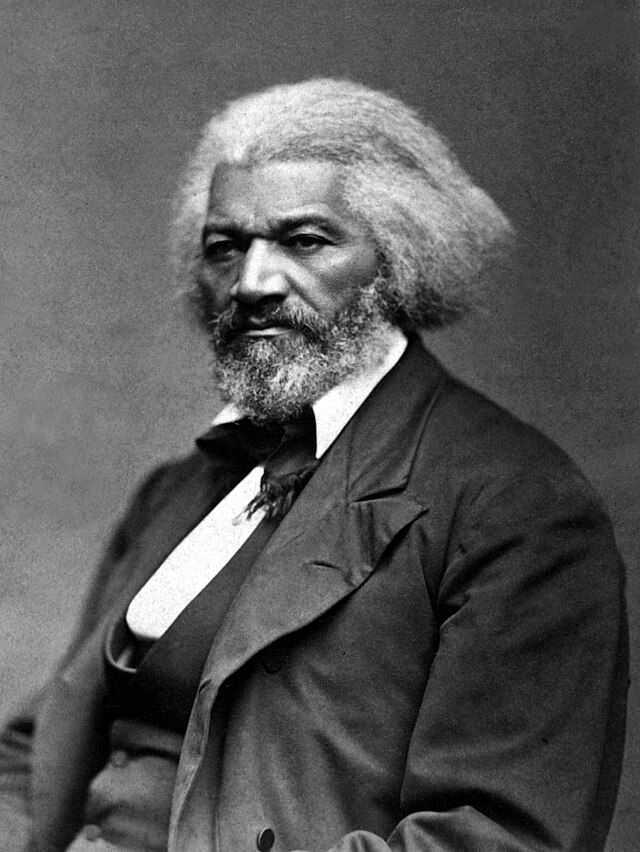
American abolitionist, orator, writer, and statesman who escaped slavery and became one of the most influential voices of nineteenth-century America.
Overview
Frederick Douglass was an American abolitionist, orator, writer, and statesman who escaped from slavery and went on to become one of the most commanding intellectual and political figures of the nineteenth century. His autobiographies exposed the realities of American slavery to international audiences, his speeches helped shape public opinion, and his political arguments influenced generations of reformers. He remains a foundational figure in both the history of abolition and the broader tradition of American democratic thought.
Enslaved Life and Escape
Douglass was born enslaved in Talbot County, Maryland, around 1818 under the name Frederick Augustus Washington Bailey. He never knew his exact birthday — a cruelty of slavery he noted throughout his life — and he was separated from his mother as an infant. As a boy he was sent to Baltimore, where his enslaver's wife began teaching him the alphabet before being forbidden to continue. Douglass continued learning to read and write in secret, often trading bread with poor white children for lessons. He later wrote that literacy revealed to him the "pathway from slavery to freedom." After years of planning and one failed attempt, he escaped to New York in 1838 disguised as a sailor, aided by his future wife Anna Murray and a free Black sailor's identification papers.
Abolitionist and Writer
In the North, Douglass quickly became a powerful speaker on the abolitionist lecture circuit. In 1845 he published Narrative of the Life of Frederick Douglass, an American Slave, an unsparing account of his experience that sold thousands of copies and exposed him to the danger of recapture. To escape that threat he toured Britain and Ireland, where supporters raised the funds to purchase his legal freedom. Returning to the United States, he founded and edited the abolitionist newspaper The North Star from Rochester, New York, and used its pages to press for immediate emancipation, women's suffrage, and equal citizenship. He was the only African American to attend the 1848 Seneca Falls Convention, where he publicly supported the radical demand for women's right to vote.
Civil War and Later Career
During the Civil War, Douglass urged President Abraham Lincoln to allow Black men to fight in the Union Army and personally recruited for the celebrated 54th Massachusetts Regiment, in which two of his own sons served. After emancipation, he continued to fight for civil rights during the Reconstruction era, opposing the return of white supremacist rule in the South. He held a series of federal appointments, including U.S. Marshal of the District of Columbia, Recorder of Deeds, and U.S. Minister-Resident and Consul General to Haiti. He revised and expanded his autobiographies twice more during his life, leaving one of the most detailed personal records of the era.
Legacy
Douglass died in 1895 in Washington, D.C., shortly after delivering a speech at a women's rights meeting. His legacy is enormous. His writings are read in classrooms across the world, his arguments about the meaning of the Fourth of July remain touchstones of American political thought, and his life offered a living rebuttal to every proslavery defense of racial hierarchy.
Did You Know?
- Douglass never knew his exact birthday, a fact he later cited as an injustice of slavery.
- He taught himself to read by trading bread with poor white children.
- He was the only African American to attend the 1848 Seneca Falls women's rights convention.
- Two of his sons fought in the famed 54th Massachusetts Regiment during the Civil War.