> SEPTEMBER 11 ATTACKS
Coordinated terrorist attacks on September 11, 2001 killed nearly 3,000 people and reshaped U.S. and global security policy.
Overview
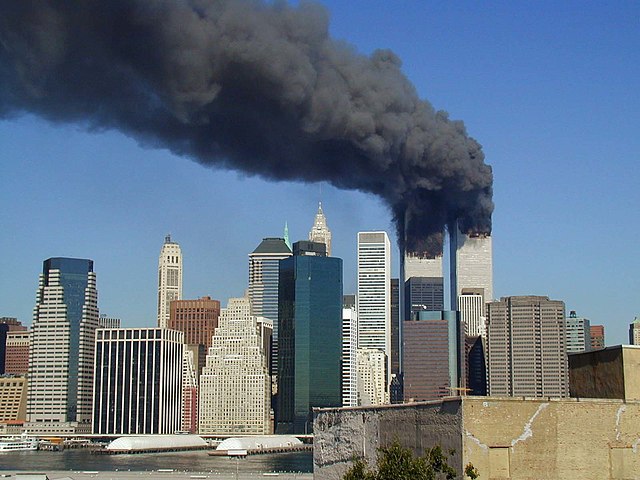
The September 11 Attacks were a series of coordinated terrorist hijackings carried out in the United States on September 11, 2001, by 19 militants linked to al-Qaeda. Four commercial airliners were seized during the morning. Two were flown into the Twin Towers of the World Trade Center in New York City, one struck the Pentagon in Arlington, Virginia, and a fourth crashed in Pennsylvania after passengers fought back against the hijackers.
Nearly 3,000 people were killed, making 9/11 the deadliest terrorist attack in modern history. Victims included civilians from many countries, airline crews, firefighters, police officers, and emergency medical workers. The attacks caused massive destruction, especially in lower Manhattan, and had immediate political, military, economic, and cultural consequences around the world.
Background
Al-Qaeda, led by Osama bin Laden, had declared hostility toward the United States during the 1990s. The group had already been linked to major attacks, including the 1998 bombings of U.S. embassies in East Africa and the 2000 bombing of the USS Cole. Its leaders aimed to strike symbolic American targets and provoke a broader conflict.
The hijackers entered the United States in the months before the attacks and used flight training schools to prepare. U.S. intelligence agencies had collected fragments of warning information before September 11, but these signals were not fully connected in time to prevent the plot. Later investigations, especially the 9/11 Commission Report, examined these intelligence and security failures in detail.
The Event
American Airlines Flight 11 crashed into the North Tower of the World Trade Center at 8:46 a.m. United Airlines Flight 175 hit the South Tower at 9:03 a.m., confirming that the country was under attack. At 9:37 a.m., American Airlines Flight 77 struck the Pentagon, severely damaging part of the building.
United Airlines Flight 93 was hijacked as well, but passengers and crew attempted to regain control after learning of the earlier attacks. The plane crashed near Shanksville, Pennsylvania, at 10:03 a.m. Investigators concluded that it was likely headed toward a target in Washington, D.C.
The South Tower collapsed at 9:59 a.m., followed by the North Tower at 10:28 a.m. The collapses destroyed surrounding buildings, filled the area with debris and toxic dust, and created a long and dangerous rescue and recovery operation. Emergency responders worked under extreme conditions, and many lost their lives trying to save others.
Impact and Legacy
The September 11 Attacks transformed U.S. domestic and foreign policy. Within weeks, the United States launched military operations in Afghanistan to remove the Taliban government, which had sheltered al-Qaeda. The attacks also influenced later military actions, surveillance practices, and international counterterrorism cooperation.
At home, airport and transportation security changed dramatically. The U.S. created the Department of Homeland Security in 2002, and the Transportation Security Administration took on expanded screening duties. The attacks also led to debates over civil liberties, intelligence sharing, immigration controls, and emergency preparedness.
The rebuilding of the World Trade Center site became a major national project. The National September 11 Memorial & Museum now commemorates the victims in New York, while memorials at the Pentagon and near Shanksville honor those lost there. Each year, ceremonies mark the anniversary and remember the people affected.
Did You Know?
- The attacks killed 2,977 victims, not including the 19 hijackers.
- People from more than 90 countries were among those killed on September 11, 2001.
- The World Trade Center complex had seven buildings; in addition to the Twin Towers, 7 World Trade Center also collapsed later that day.
- United Flight 93 passengers and crew are widely credited with preventing the hijackers from reaching their intended target.
- The phrase “9/11” became the widely used shorthand for the attacks and their aftermath.