> ROSETTA STONE
Ancient Egyptian decree inscribed in three scripts that enabled scholars to decipher hieroglyphs.
Overview
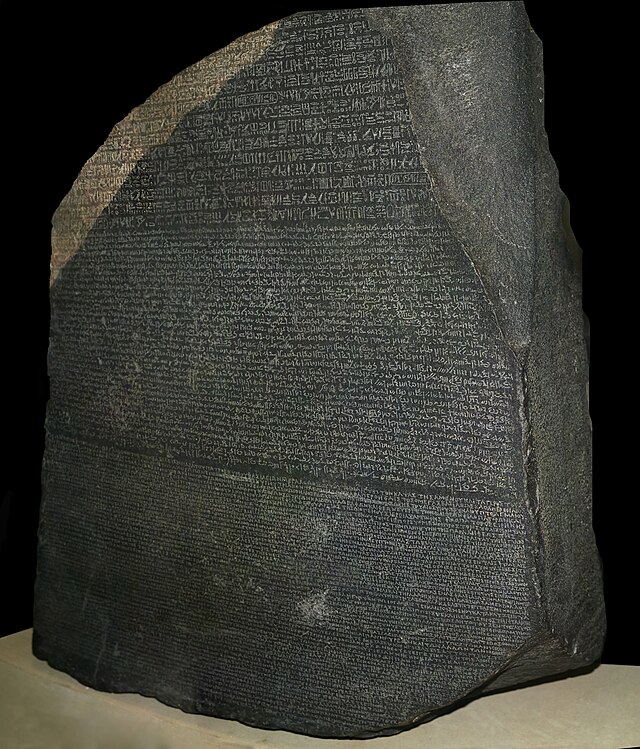
The Rosetta Stone is one of the most famous ancient documents in the world because it made the decipherment of Egyptian hieroglyphs possible. It is a granodiorite stele carved in 196 BCE during the reign of Ptolemy V. The stone records a decree issued by Egyptian priests and presents the same text in three scripts: hieroglyphic, Demotic, and Ancient Greek.
Because scholars could already read Greek, the Rosetta Stone became the key to unlocking the meaning of the previously misunderstood Egyptian writing system. Its discovery transformed the study of ancient Egypt and laid the foundation for modern Egyptology.
Background
The decree on the Rosetta Stone was created in the Ptolemaic Kingdom, when Egypt was ruled by a Greek-speaking dynasty established after the conquests of Alexander the Great. Although the rulers were Macedonian in origin, they governed an Egyptian population with deep religious and cultural traditions.
The stone was discovered in 1799 by French soldiers near the town of Rosetta, now Rashid, during Napoleon’s campaign in Egypt. Its importance was quickly recognized because of the trilingual inscription. After the British defeated the French in Egypt, the stone was transferred to British possession under the terms of the Capitulation of Alexandria in 1801. Since 1802, it has been housed in the British Museum in London, where it remains one of the museum’s most visited objects.
Content and Scripts
The inscription is a priestly decree affirming the royal cult of Ptolemy V and listing honors granted to him. While the political content is important, the true historical value of the Rosetta Stone lies in its three parallel texts.
The top section is written in Egyptian hieroglyphs, the formal script used for monumental and religious inscriptions. The middle section is in Demotic, a cursive script used for daily administrative and legal purposes in Egypt. The bottom section is in Ancient Greek, the language of the ruling elite in Ptolemaic Egypt.
Although the stone is broken and parts of the text are missing, enough remained for scholars to compare the Greek text with the Egyptian scripts. This comparison was essential in proving that hieroglyphs could represent sounds as well as ideas, overturning earlier assumptions.
Decipherment and Legacy
Several scholars contributed to understanding the Rosetta Stone, but the most famous breakthrough came from Jean-François Champollion in the 1820s. Building on earlier work by Thomas Young and others, Champollion used his knowledge of Coptic and close comparison of the scripts to show that hieroglyphs had phonetic elements. His work opened the door to reading inscriptions on temples, tombs, and papyri across Egypt.
The Rosetta Stone changed history not because of what the decree says, but because it restored a lost language system. Once hieroglyphs could be read, historians gained direct access to ancient Egyptian religion, government, literature, and everyday life. Today, the stone remains a symbol of translation, discovery, and the recovery of the ancient past.
Did You Know?
- The Rosetta Stone is not a complete monument; it is only a fragment of a larger stele.
- The name “Rosetta Stone” comes from the European name of the town where it was found; the modern Arabic name is Rashid.
- Jean-François Champollion announced a major breakthrough in deciphering hieroglyphs in 1822.
- The phrase “Rosetta stone” is now often used metaphorically to mean any key that helps decode a mystery.