> BAYEUX TAPESTRY
An 11th-century embroidered cloth that depicts the Norman Conquest and remains a key source for medieval history.
Overview
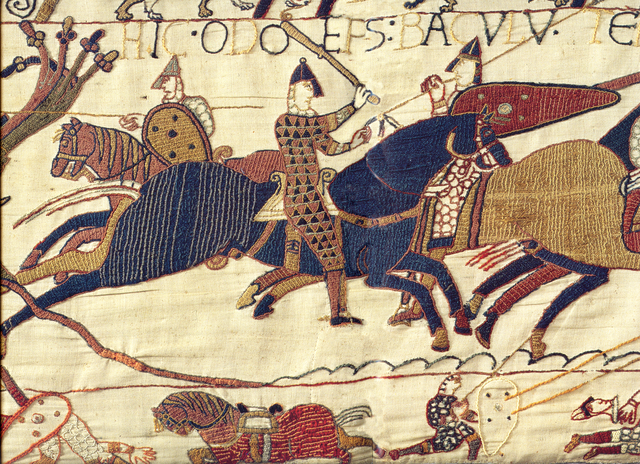
The Bayeux Tapestry is one of the most famous works of medieval art and one of the most valuable visual sources for the Norman Conquest of England. Despite its name, it is not a true tapestry but a long embroidered linen cloth, measuring about 70 meters in length. It tells the story leading up to the Battle of Hastings in 1066 and the victory of William, Duke of Normandy, later known as William the Conqueror.
Created in the 11th century, probably in the 1070s, the Bayeux Tapestry combines narrative, political messaging, and detailed observation of daily life, warfare, and seafaring. Its scenes are accompanied by Latin inscriptions that identify people and explain events. Today, it is preserved in Bayeux, Normandy, and remains a major document for historians studying medieval Europe.
Background
The tapestry was likely commissioned not long after the Norman Conquest. Although its exact patron is unknown, many historians have linked it to Bishop Odo of Bayeux, William’s half-brother and an important supporter of the conquest. The work may have been designed in Normandy but embroidered in England, where skilled Anglo-Saxon needleworkers were highly respected.
Its purpose was not simply decorative. The embroidery presents a version of events that supports the Norman claim to the English throne. It begins with King Edward the Confessor and Harold Godwinson, then shows Harold’s journey to Normandy, his oath to William, and finally the invasion and battle that changed English history. As a result, the Bayeux Tapestry is both an artwork and a political statement.
Content and Imagery
The main narrative unfolds in a sequence of vivid scenes filled with soldiers, horses, ships, clergy, nobles, and messengers. It also includes architectural details, weapons, armor, and agricultural life, making it an exceptional source for historians of material culture. The depiction of Norman ships crossing the Channel is especially important for understanding medieval naval logistics.
One of the most discussed scenes shows Harold swearing an oath to William, a key moment in the Norman argument that Harold later broke his promise by taking the English crown. Another famous scene depicts Halley’s Comet, which appeared in 1066 and was interpreted at the time as a sign of major change. The final scenes focus on the Battle of Hastings, including the death of Harold, though scholars continue to debate exactly which figure in the embroidery represents him.
The borders above and below the main scenes contain animals, fables, and symbolic imagery. These decorative margins add complexity and may comment indirectly on the central action.
Historical Importance and Legacy
The Bayeux Tapestry is invaluable because it offers a near-contemporary account of one of the defining events in English and Norman history. While it is not neutral and must be read critically, it provides evidence unavailable in written chronicles alone. Historians use it to study medieval warfare, kingship, clothing, shipbuilding, and political propaganda.
Its survival is remarkable. Over centuries, it was moved, rolled, displayed, and protected during times of conflict, including the French Revolution and World War II. Today, it remains a cornerstone of medieval studies and a powerful example of how visual storytelling shaped historical memory.
The Bayeux Tapestry also continues to influence modern culture. It has inspired books, documentaries, museum exhibitions, and artistic reinterpretations. For both scholars and general audiences, it remains one of the clearest windows into the 11th-century world.
Did You Know?
- The Bayeux Tapestry is embroidery, not a woven tapestry, because its images were stitched onto linen.
- It includes more than 600 human figures, along with horses, ships, animals, and buildings.
- The Latin captions help identify major people and events, making the story easier to follow.
- Halley’s Comet appears in the embroidery, one of the earliest known visual depictions of the comet.
- Parts of the final section are missing, so the original ending of the story is not fully preserved.