> EPIC OF GILGAMESH
One of the world’s oldest surviving literary works, the Epic of Gilgamesh explores kingship, friendship, and mortality in ancient Mesopotamia.
Overview
The Epic of Gilgamesh is one of the oldest known works of literature and a foundational text from ancient Mesopotamia. It centers on Gilgamesh, the semi-divine king of Uruk, and follows his transformation from a proud ruler into a figure shaped by friendship, grief, and the search for meaning. Though its stories developed over centuries, the epic is most often associated with a Standard Babylonian version compiled from earlier Sumerian and Akkadian traditions.
For historians, the epic is valuable not only as literature but also as evidence of Mesopotamian beliefs, political ideals, and religious thought. It reveals how ancient people understood power, the gods, human limits, and the inevitability of death.
Background
The earliest stories about Gilgamesh likely emerged in Sumerian poems around the late third millennium BCE. These separate tales were later woven into a larger Akkadian narrative. The best-known version was likely edited by the scholar-priest Sîn-lēqi-unninni, probably during the late second or early first millennium BCE.
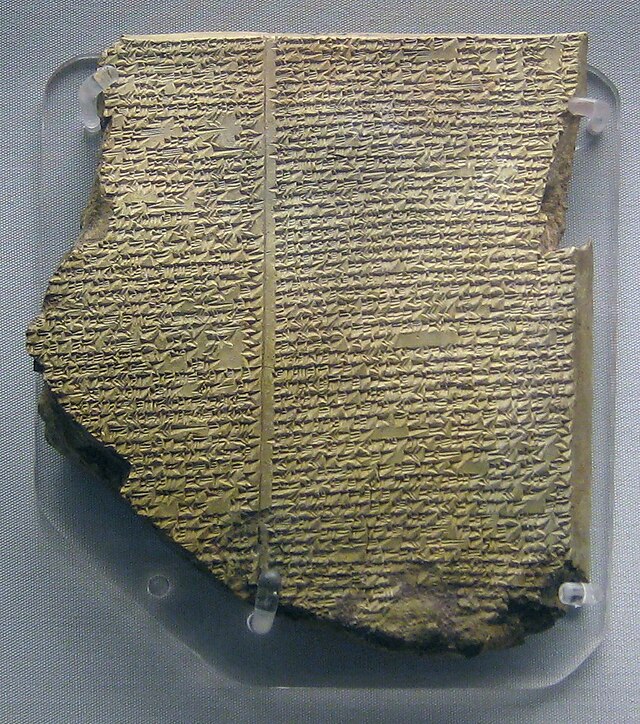
The most famous surviving tablets were found in the library of the Assyrian king Ashurbanipal at Nineveh in the nineteenth century. Written in cuneiform on clay tablets, the text had to be painstakingly reconstructed from fragments. Because many copies existed in different languages and periods, the Epic of Gilgamesh also shows how texts were transmitted and adapted across the ancient Near East.
Content and Themes
The story begins with Gilgamesh as a powerful but oppressive king. The gods create Enkidu, a wild man, to challenge him. Instead, the two become close companions. Together they undertake heroic but dangerous exploits, including the defeat of Humbaba, guardian of the Cedar Forest, and the killing of the Bull of Heaven.
After these acts, the gods punish them, and Enkidu dies. His death marks the turning point of the epic. Gilgamesh, devastated by grief, becomes obsessed with escaping death. He travels in search of Utnapishtim, a survivor of a great flood who was granted immortality by the gods.
This part of the epic contains some of its most enduring themes: friendship, fame, civilization, divine power, and mortality. Gilgamesh ultimately learns that eternal life is not meant for humans. Instead, the poem suggests that wisdom lies in accepting human limits and valuing one’s achievements, community, and city.
Historical Importance and Legacy
The Epic of Gilgamesh is essential to the study of ancient literature, religion, and history. It preserves early Mesopotamian ideas about kingship, where rulers were expected to be strong yet just, and where the gods remained deeply involved in human affairs. The poem also provides insight into urban identity, especially through its emphasis on the walls and grandeur of Uruk.
Its flood narrative has attracted particular attention because it parallels later stories in the Hebrew Bible, though it comes from an older Mesopotamian tradition. More broadly, the epic has influenced modern scholarship, comparative mythology, and world literature courses. Today, it is widely read as a landmark text because its questions about loss, ambition, and death still feel strikingly human.
Did You Know?
- The historical Gilgamesh may have been a real king of Uruk, possibly ruling sometime in the early dynastic period of Mesopotamian history.
- The epic survives in fragmentary form, so modern translations are based on reconstructed tablets from multiple sites and periods.
- A major section of the poem includes a flood story told by Utnapishtim, which predates the biblical story of Noah.
- The work was written in cuneiform, one of the world’s earliest writing systems, impressed onto clay tablets.
- Enkidu’s death is the emotional center of the epic and drives Gilgamesh’s search for immortality.