> DEAD SEA SCROLLS
Ancient Jewish manuscripts found near Qumran that transformed the study of the Hebrew Bible and Second Temple Judaism.
Overview
The Dead Sea Scrolls are a collection of ancient Jewish manuscripts discovered in caves near Qumran, close to the Dead Sea, beginning in 1947. Dating from about the 3rd century BCE to the 1st century CE, they include biblical texts, religious writings, legal documents, hymns, and community rules. These scrolls are among the most important archaeological finds of the 20th century because they preserve some of the oldest known copies of books from the Hebrew Bible.
The manuscripts were written mainly in Hebrew, with some in Aramaic and a smaller number in Greek. Most were copied onto parchment, while a few were written on papyrus, and one famous example, the Copper Scroll, was engraved on metal. Their survival was aided by the dry climate and cave conditions of the Judean Desert.
Background
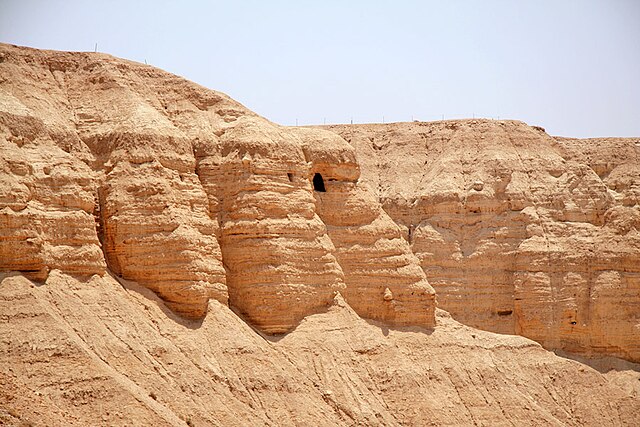
The first scrolls came to light when Bedouin shepherds reportedly found jars containing ancient manuscripts in a cave. Over the following years, archaeologists and local finders uncovered scroll fragments and documents in eleven caves near Qumran. Excavations at the nearby settlement raised questions about who had produced or stored the manuscripts.
Many scholars have linked the scrolls to a Jewish sect often identified with the Essenes, a group described in ancient sources as strict, communal, and deeply concerned with ritual purity. However, debate continues. Some researchers argue that the collection may reflect multiple Jewish libraries brought to the caves during the Roman advance in the 1st century CE. Whatever their exact origin, the scrolls provide direct evidence of Jewish life, belief, and scripture in the late Second Temple period.
Content and Texts
The Dead Sea Scrolls contain parts of nearly every book of the Hebrew Bible, except Esther. Among the most important biblical manuscripts is the Great Isaiah Scroll, one of the best-preserved texts from the collection. These copies allow scholars to compare later biblical manuscripts with much older versions, showing both remarkable stability and some textual variation.
Non-biblical writings are just as significant. They include sectarian works such as the Community Rule, the Damascus Document, and the War Scroll, as well as commentaries, prayers, wisdom literature, and apocalyptic texts. These writings reveal a world shaped by expectation of divine judgment, careful interpretation of scripture, and disputes over law, priesthood, and religious authority.
Impact and Legacy
The Dead Sea Scrolls transformed the study of the Hebrew Bible, ancient Judaism, and the historical background of early Christianity. Before their discovery, the oldest complete Hebrew biblical manuscripts dated from around the 10th century CE. The scrolls pushed the manuscript record back by roughly a thousand years, giving scholars a much earlier window into the transmission of sacred texts.
They also showed that Judaism in this period was more diverse than once assumed. Rather than a single uniform tradition, the scrolls reflect multiple interpretations of scripture and law. This has helped historians better understand the intellectual and religious setting of Judea before the destruction of the Second Temple in 70 CE.
Today, many of the scrolls and fragments are housed in Jerusalem, especially at the Israel Museum’s Shrine of the Book. Ongoing imaging and digital preservation projects continue to recover faded writing and make these manuscripts more accessible to researchers and the public.
Did You Know?
- The Great Isaiah Scroll is one of the most complete Dead Sea Scrolls ever found.
- The Copper Scroll is unusual because it was inscribed on metal rather than written on parchment or papyrus.
- Fragments from the Dead Sea Scrolls represent parts of nearly every book of the Hebrew Bible except Esther.
- The scrolls were discovered in eleven caves near Qumran along the northwest shore of the Dead Sea.
- Modern multispectral imaging has helped scholars read damaged or faded sections invisible to the naked eye.