> ATLANTIC CHARTER
A 1941 joint declaration by Franklin D. Roosevelt and Winston Churchill that set out Allied war aims and postwar principles.
Overview
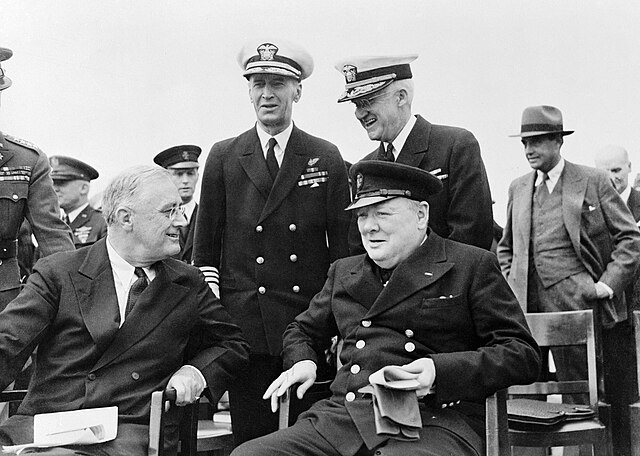
The Atlantic Charter was a joint statement issued on August 14, 1941, by U.S. President Franklin D. Roosevelt and British Prime Minister Winston Churchill. Drafted during a secret meeting aboard warships in the North Atlantic near Newfoundland, it outlined shared principles for the world after World War II. Although the United States had not yet formally entered the war, the document signaled growing American support for Britain and opposition to Axis expansion.
Rather than a formal treaty, the Atlantic Charter was a declaration of goals. It became one of the most important wartime documents of the 20th century because it defined key Allied war aims and helped shape the future international order. Its ideas later influenced the United Nations and debates over self-determination, trade, and collective security.
Background
By mid-1941, Nazi Germany controlled much of Europe, and Britain stood under severe pressure. Roosevelt wanted to support Britain while navigating strong isolationist sentiment at home. Churchill sought firmer American backing, both military and moral.
The two leaders met in secret from August 9 to 12, 1941, off the coast of Newfoundland. Their discussions produced a short but influential statement designed to present a united vision for peace and security. The timing mattered: the declaration came months before the Japanese attack on Pearl Harbor in December 1941 and before the United States officially entered World War II.
The Atlantic Charter also served as propaganda in the best sense of the word: it reassured occupied peoples that the Allies were fighting for more than military victory. It presented the war as a struggle for principles, not simply power.
Content
The Atlantic Charter set out eight main points. Among its most important themes were no territorial expansion, no border changes without the consent of the people concerned, and respect for the right of all peoples to choose their own form of government. It also called for improved access to trade and raw materials, economic cooperation, social welfare, freedom from fear and want, freedom of the seas, and disarmament of aggressor nations after the war.
One of the most discussed principles was self-determination. Many people in colonized regions interpreted the Charter as support for independence movements. However, Churchill did not intend it to apply fully to the British Empire, which led to criticism and later disputes.
The Charter’s language was broad and idealistic, which helped it gain international attention. In January 1942, 26 nations fighting the Axis endorsed its principles in the Declaration by United Nations.
Impact and Legacy
The Atlantic Charter had lasting influence far beyond 1941. It helped define Allied diplomacy and provided a moral framework for the war effort. Its principles fed directly into plans for a postwar international system based on cooperation rather than balance-of-power politics alone.
The document is especially important in the history of the United Nations. Ideas such as collective security, economic collaboration, and peace through international organization reflected the Charter’s vision. At the same time, its promises exposed tensions between anti-imperial rhetoric and imperial practice. Nationalists in Asia, Africa, and the Middle East often cited the Charter when pressing for decolonization after the war.
For historians, the Atlantic Charter marks a turning point in U.S.-British relations and in the development of modern international ideals. Though not legally binding, it became one of the defining political documents of World War II.
Did You Know?
- Roosevelt and Churchill met aboard the USS Augusta and HMS Prince of Wales during their 1941 conference.
- The Atlantic Charter was issued before the United States formally entered World War II.
- Its principles influenced the 1942 Declaration by United Nations, an early step toward the modern UN.
- Colonized peoples around the world cited the Charter’s language on self-determination to support independence movements.