> DECLARATION OF INDEPENDENCE
Founding document of the United States, declaring the thirteen American colonies free from British rule and asserting universal rights.
Overview
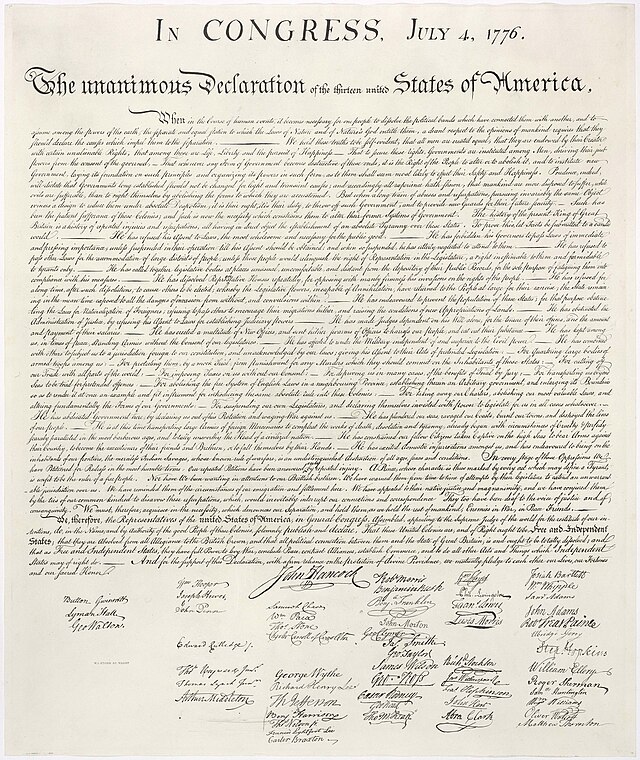
The Declaration of Independence is the founding document of the United States, adopted by the Second Continental Congress on July 4, 1776. It formally announced that the thirteen American colonies no longer considered themselves part of the British Empire and laid out the political philosophy on which the new nation would be built. Its best-known sentence — "We hold these truths to be self-evident, that all men are created equal" — has become one of the most quoted statements in modern political history.
Background and Drafting
Tensions between the American colonies and the British crown had been escalating for more than a decade, driven by disputes over taxation, representation, and military occupation. By the spring of 1776, the Continental Congress was moving toward a formal break. On June 11, a committee of five — Thomas Jefferson, John Adams, Benjamin Franklin, Roger Sherman, and Robert R. Livingston — was appointed to draft the document. Jefferson did the bulk of the writing over seventeen days in a Philadelphia boarding house, drawing on earlier state declarations, English constitutional tradition, and Enlightenment thinkers such as John Locke. The committee and later Congress itself edited the text, most notably striking out Jefferson's long passage denouncing the slave trade.
Structure and Ideas
The Declaration has three main parts. The preamble sets out a philosophy of government: that people have unalienable rights including "Life, Liberty and the pursuit of Happiness," that governments derive their just powers from the consent of the governed, and that people have the right to alter or abolish governments that fail to protect those rights. A long middle section lists specific grievances against King George III — from dissolving colonial legislatures to imposing taxes without consent — framing the break as a reluctant response to tyranny. The final section, written in the formal language of an international treaty, declares the colonies "Free and Independent States" with the power to wage war, conclude peace, and trade as sovereign entities.
Legacy
Congress ratified the text on July 4, 1776, which became the nation's founding national holiday. Most of the fifty-six signers, however, did not actually sign the famous engrossed parchment copy until August 2 or later. The Declaration did not create a functioning government — that would come with the Articles of Confederation and later the U.S. Constitution — but it established a moral and rhetorical foundation that shaped American and global politics for centuries. It has been cited by abolitionists, suffragists, civil rights leaders, and independence movements from Vietnam to Eastern Europe. The original engrossed copy is preserved at the National Archives in Washington, D.C., in a specially designed encasement.
Did You Know?
- Jefferson drafted the document in about seventeen days.
- The famous July 4 date refers to adoption; most signatures were added weeks later.
- A passage condemning the slave trade was removed before adoption.
- The word "unalienable" in the original text is often misquoted as "inalienable."